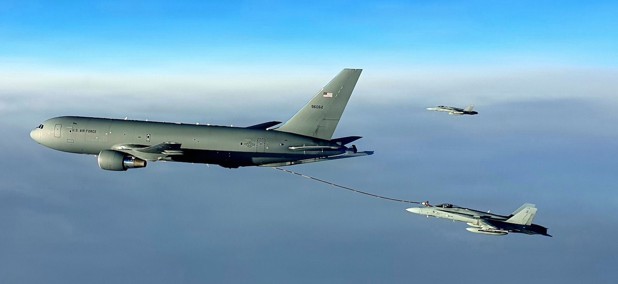
Air Force planners are evaluating whether future aerial refueling tankers could be autonomous or optionally manned, following progress in the Navy's unmanned tanker programs.
Key facts
- •The Air Force requested $13 million for 'advanced tanker systems' in its 2027 budget.
- •The Navy's MQ-25 Stingray drone tanker has received approval for low-rate production.
- •The Navy has ordered a total of 14 MQ-25 aircraft to date.
- •Current Air Force KC-46 tankers can carry over a thousand tons of fuel and fly nearly 7,400 miles.
- •Lt. Gen. Daniel Tulley stated that the Air Force is not yet employing fully autonomous large aircraft.
U.S. Air Force officials are considering the feasibility of autonomous or optionally manned tankers for their future fleet. Lt. Gen. Daniel Tulley of the Air Mobility Command stated that while current refueling solutions remain manned, the service is exploring advanced systems that could potentially operate without a crew. This shift in planning follows the Navy's recent progress in moving its Boeing MQ-25 Stingray unmanned tanker toward low-rate production.
By the numbers
Evaluating Future Tanker Requirements
During the Air, Space, & Cyber 2026 conference, Lt. Gen. Tulley emphasized that any future tanker must be highly connected and capable of self-defense. While the Air Force continues to procure the manned Boeing KC-46 Pegasus, it has requested $13 million for 'advanced tanker systems' in its 2027 budget. Tulley noted that while large aircraft are already capable of automated takeoff, flight, and landing, the Air Force has not yet integrated these systems into a broader, fully autonomous operational framework.
Operational Scale and Challenges
A primary challenge for an unmanned Air Force tanker is the requirement for large-scale fuel capacity and long-range flight capabilities. Tulley highlighted the disparity between the Navy's MQ-25, which carries 7.5 tons of fuel, and the KC-46, which carries over a thousand tons and has a range of nearly 7,400 miles. Developing an unmanned system that matches the range and capacity of current large tankers remains a significant technical hurdle for the service.
Advertisement
This article was independently rewritten by ManyPress editorial AI from reporting originally published by Military Times, Defense One.