Experts say there is no historical or archaeological evidence that Vikings used flaming arrows to set funeral boats adrift at sea, a common trope in modern film and television.
Key facts
- •Archaeologists state there is no evidence that Vikings used flaming arrows to ignite funeral boats at sea.
- •Historical accounts, such as those by Ahmad ibn Fadlan, describe Viking funeral ships being burned on land, not on the water.
- •Experts note that a ship set ablaze at sea would likely sink before a body could be properly cremated.
- •The 1958 film 'The Vikings' is cited by researchers as a likely origin for the popularization of the fire-arrow funeral trope.
- •Viking funerary practices involving fire were typically conducted on land, as evidenced by the ninth-century Myklebust ship.
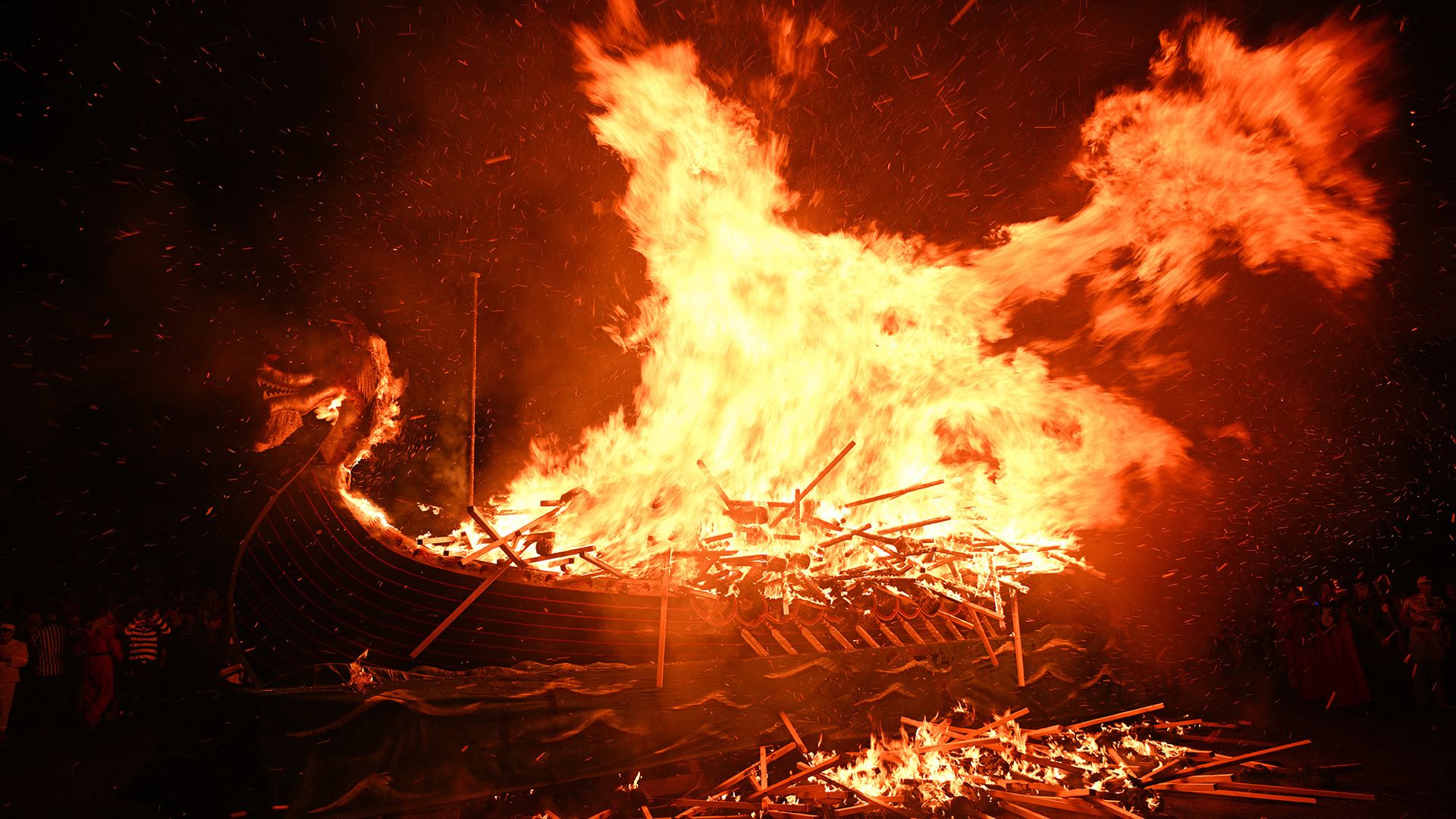
While the image of a Viking funeral involving a boat set ablaze by a flaming arrow is a staple of popular culture, experts in archaeology and anthropology state that the practice is not supported by historical evidence. Scholars note that such a ritual would be difficult to execute and that there is no archaeological record of ships being cremated in this manner while adrift.
Archaeological and Historical Evidence
Archaeologists emphasize that there is no physical evidence for the fire-arrow burial motif. While Vikings did cremate their dead and sometimes burned ships, these ceremonies typically occurred on land. For example, the ninth-century Myklebust ship in Norway was burned as part of a funerary practice before being buried in a mound. Experts note that shipwrecks containing human remains are extremely rare, and none from the Viking Age have been identified that would support the sea-burial theory.
Practical and Historical Challenges
A 10th-century account by Arab traveler Ahmad ibn Fadlan describes a Viking chieftain being placed on a boat that was set on fire, but the boat was on land and ignited by a mourner, not by an arrow. Experts like Matthias Toplak of the Viking Museum Haithabu argue that using flaming arrows to ignite a ship at sea is unrealistic, as it would be difficult to achieve the high temperatures required for cremation. Furthermore, a burning ship adrift could pose hazards to harbor facilities or other vessels.
Origins of the Myth
Scholars suggest the popular image of the flaming-arrow funeral likely stems from 20th-century media. Howard Williams of the University of Chester points to the 1958 film 'The Vikings' as a primary source for the trope. While legendary accounts in literature, such as the funeral of the god Baldr or the burial of the king Scyld Scefing in 'Beowulf,' feature ships set adrift and alight, these are considered mythical or literary rather than historical accounts.
Advertisement
This article was independently rewritten by ManyPress editorial AI from reporting originally published by Live Science.