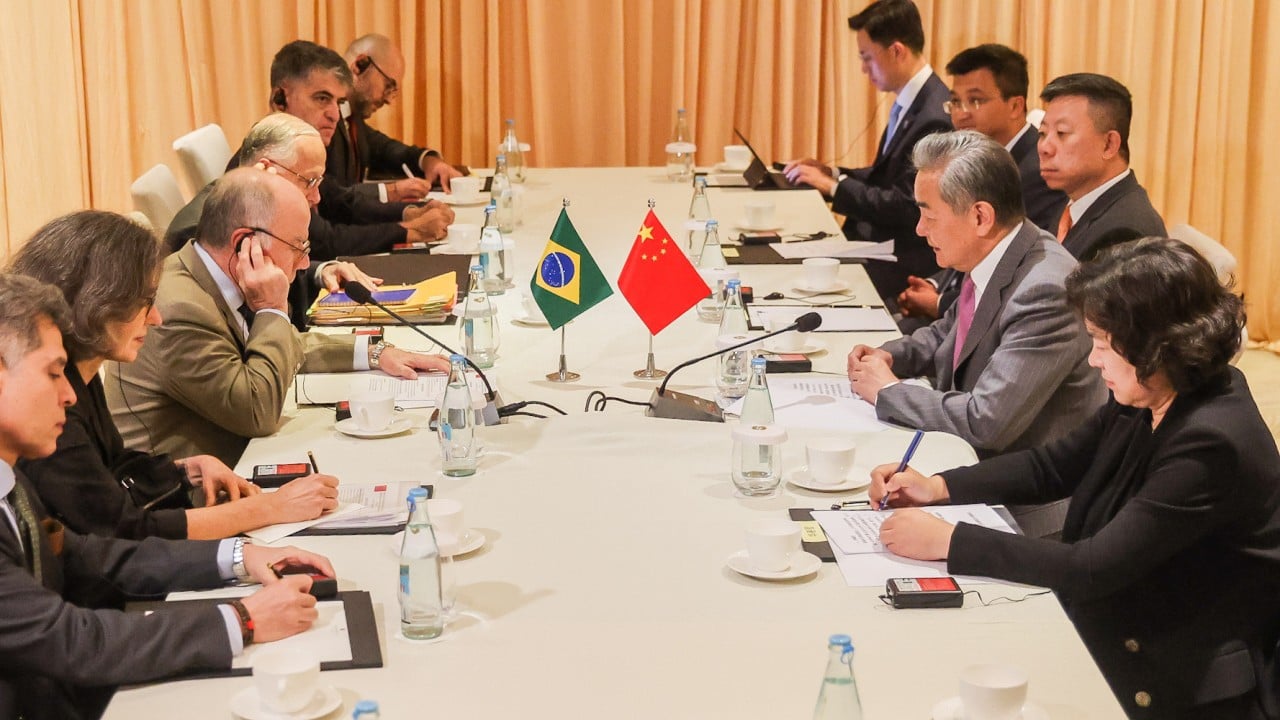
Chinese Foreign Minister Wang Yi met with his Brazilian counterpart to express support for Brazil's sovereignty after the US implemented a 25 percent tariff on Brazilian goods.
Key facts
- •Chinese Foreign Minister Wang Yi and Brazilian Foreign Minister Mauro Vieira met in Manila on Wednesday.
- •The meeting occurred during the 59th Asean foreign ministers' meeting.
- •The US recently imposed a 25 percent tariff on Brazilian goods.
- •China's pledge of support for Brazil's sovereignty was paired with a request for Brazil to support China's core interests.
- •The US tariffs are partially tied to the prosecution of former president Jair Bolsonaro.
- •The US has designated the First Capital Command and the Red Command as foreign terrorist organizations.
Chinese Foreign Minister Wang Yi met with Brazilian Foreign Minister Mauro Vieira on Wednesday in Manila to discuss bilateral relations. The meeting took place on the sidelines of the 59th Association of Southeast Asian Nations (Asean) foreign ministers' meeting, shortly after the United States implemented a 25 percent tariff on Brazilian goods.
Diplomatic support and mutual interests
According to a Chinese foreign ministry statement, Wang Yi affirmed that Beijing will continue to support Brazil in safeguarding its sovereignty, security, and development interests. The ministry characterized Brazil as an emerging economy with significant global influence and a representative voice for the Global South. In return, Wang requested that Brazil continue to support China regarding its core interests. This terminology is used by Beijing to refer to issues concerning Taiwan, Tibet, Xinjiang, and Hong Kong.
Context of US measures
The new US tariffs are linked in part to the prosecution of former Brazilian president Jair Bolsonaro. Additionally, the US government recently designated the First Capital Command and the Red Command as foreign terrorist organizations.
Advertisement
This article was independently rewritten by ManyPress editorial AI from reporting originally published by South China Morning Post.