A satellite tasked with boosting NASA's Swift observatory into a higher orbit has spun out of control, prompting an urgent recovery effort by its operator, Katalyst Space Technologies.
Key facts
- •The Link satellite is a refrigerator-sized craft owned by Katalyst Space Technologies.
- •Two of the satellite's three reaction wheels have stopped functioning.
- •Katalyst is using plasma engines to attempt to arrest the spacecraft's spin.
- •The mission is valued at $30 million under a contract with NASA.
- •The Link satellite launched on July 3 to pursue the Swift observatory.
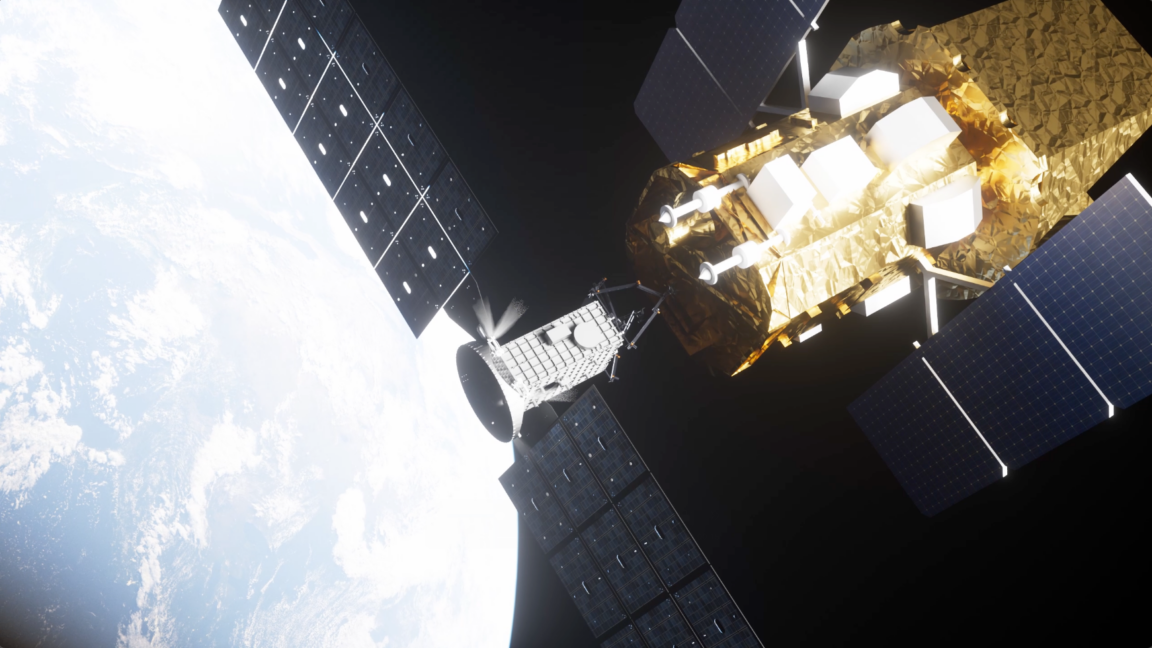
The Link satellite, a refrigerator-sized spacecraft operated by startup Katalyst Space Technologies, began spinning uncontrollably in orbit one week ago. The satellite is currently on a mission to rescue NASA's $500 million Swift gamma-ray observatory by boosting its orbit before it re-enters the atmosphere. Engineers are working from a control center near Denver to stabilize the craft after two of its three reaction wheels failed and issues were detected with its cold gas thrusters.
By the numbers
Mission status and recovery efforts
The Link satellite launched on July 3 under a $30 million NASA contract, marking the agency's first commercial satellite servicing mission. Despite the current spin, Katalyst CEO Ghonhee Lee stated that the spacecraft's power supply, rendezvous hardware, and three xenon-fueled electric thrusters remain healthy. Ground teams are currently using these electric thrusters to gradually slow the satellite's rotation, utilizing the engines' two-axis gimbals for attitude control.
Time constraints for the rescue
The mission faces a strict timeline, as the Swift observatory is gradually losing altitude due to aerodynamic drag. If the Link satellite cannot be stabilized and maneuvered to capture Swift within the next few months, the observatory will drop too low for a successful rescue. Katalyst was given less than one year by NASA to prepare the mission from contract award to launch.
Timeline
- July 3The Link satellite launched to begin its pursuit of the Swift observatory.
- One week agoThe Link satellite began spinning out of control while in orbit.
- Friday afternoonKatalyst ground teams were working to stabilize the spacecraft.
Advertisement
This article was independently rewritten by ManyPress editorial AI from reporting originally published by Ars Technica.