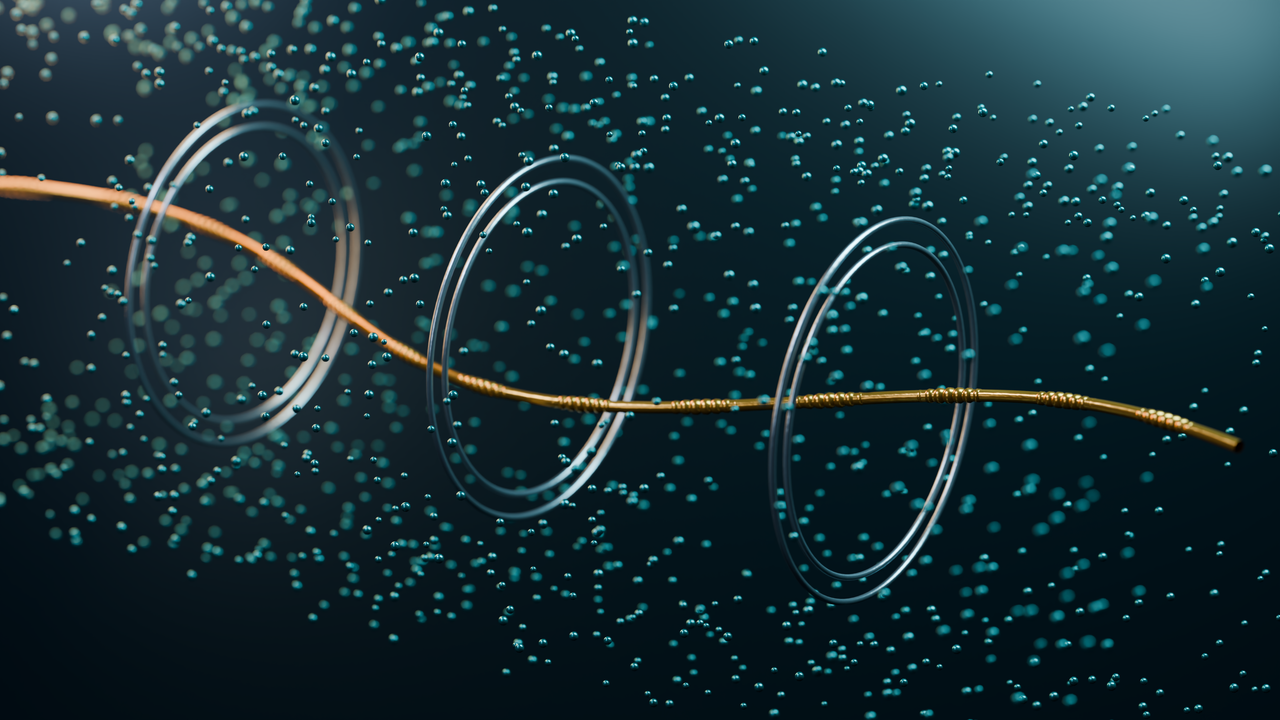
Scotland's Astronomer Royal Catherine Heymans examines the theoretical possibility that our universe is a computer simulation.

Key facts
- •CERN uses a 27-kilometre ring of superconducting magnets to study subatomic particles.
- •The standard model of particle physics does not explain dark matter, dark energy, or neutrino flavour changes.
- •Elon Musk proposed in 2016 that there is a one-in-billions chance that humans live in base reality.
- •Catherine Heymans is the author of 'How to Design a Universe', published in September 2026.
- •The simulation hypothesis suggests that quarks could potentially be qubits in a quantum computing system.
Catherine Heymans, the Astronomer Royal for Scotland, explores the question of whether the universe is a computer simulation. Her investigation considers whether the mathematical nature of the universe could support the existence of a virtual reality. The analysis weighs the precision of the standard model of particle physics against the limitations of current scientific understanding regarding gravity and dark matter.
By the numbers
Mathematical Models and Physical Reality
The standard model of particle physics has successfully predicted subatomic particles and their interactions, as demonstrated by the discovery of the Higgs boson at CERN. This facility features a 27-kilometre ring of superconducting magnets located 100 metres underground. However, the model fails to account for phenomena such as neutrino flavour switching or the existence of dark matter and dark energy. Furthermore, the theory of general relativity, which explains gravity, remains difficult to reconcile with quantum physics.
The Simulation Hypothesis
In 2016, Elon Musk suggested that the probability of living in 'base reality' is one in billions, arguing that future civilizations would likely create numerous virtual worlds. If the universe is entirely mathematical, it is theoretically possible that subatomic particles are actually qubits of data. However, Heymans notes that simulating a perfect virtual world would require an immense amount of energy, making a full-scale simulation highly implausible.
Alternative Possibilities
While a full simulation of the entire universe is energy-intensive, Heymans suggests that a more limited simulation focused on a single individual's consciousness is theoretically possible but unlikely. Ultimately, she cites philosopher David Chalmers, who argues that a virtual reality where individuals experience free will, love, and laughter is as genuine as any other reality.
Advertisement
This article was independently rewritten by ManyPress editorial AI from reporting originally published by New Scientist.