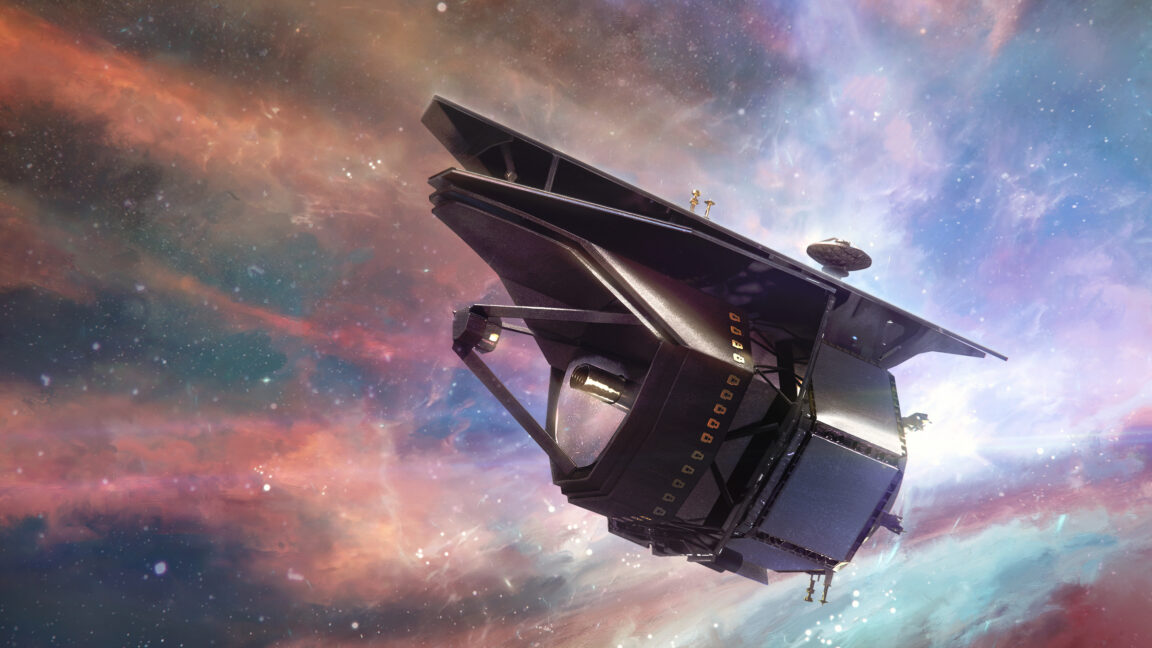
NASA has officially moved the PRIMA space telescope mission into its preliminary design phase, targeting a 2033 launch to study far-infrared wavelengths.
Key facts
- •PRIMA will operate in the far-infrared spectrum to study exoplanet formation and galaxy evolution.
- •The mission has a total development cost cap of $1.2 billion, excluding the cost of the launch.
- •NASA plans to launch the telescope no earlier than 2033.
- •The observatory will feature a 1.8-meter (5.9-foot) telescope and utilize spare parts from the Webb mission.
- •PRIMA is the first project in NASA's new 'Probe Explorer' class of space observatories.
NASA has advanced its PRIMA (Probe far-Infrared Mission for Astrophysics) space telescope to Phase B, the preliminary design and technology development stage. The mission, which is the first of a new class of 'Probe Explorer' observatories, is designed to observe the cosmos in far-infrared wavelengths that the James Webb Space Telescope cannot detect. NASA aims to launch the mission no earlier than 2033, with a development cost cap set at $1.2 billion, excluding launch expenses.
By the numbers
Scientific Objectives and Capabilities
PRIMA will utilize a 1.8-meter (5.9-foot) telescope to conduct research into exoplanet origins, galaxy growth, and the evolution of supermassive black holes. According to researchers, the mission will specifically quantify the role of water in planet formation and measure gas masses as well as carbon and oxygen abundances in planetary disks. These observations require far-infrared spectral lines that are beyond the sensitivity range of the James Webb Space Telescope. Co-investigators, including those from the University of Maryland and Caltech, intend to use the instrument to study molecular outflows in galaxies and their impact on star formation. The mission is intended to bridge the gap between smaller, lower-cost Explorer-class missions and multibillion-dollar flagship observatories.
Mission Development and Management
The PRIMA mission is being led by NASA’s Jet Propulsion Laboratory in Pasadena, California. It was selected as the sole finalist for the first Probe Explorer mission after the agency disqualified a competing X-ray observatory concept, AXIS, due to concerns regarding budget and schedule constraints. The development of PRIMA follows recommendations from an independent panel of scientists who proposed the new mission category to provide a more cost-effective alternative to flagship projects. While flagship missions often require decades to reach the launch pad, NASA is targeting a seven-year development cycle for PRIMA. The project will incorporate spare parts originally developed for the Webb telescope to help manage costs and accelerate the timeline.
Advertisement
This article was independently rewritten by ManyPress editorial AI from reporting originally published by Live Science, Ars Technica.
%20102026%20top%20art%20SOURCE%20Govee.jpg)