With no new landers or rovers planned, NASA is focusing on the SkyFall helicopter mission to explore Mars using aerial drones.
Key facts
- •The SR-1 Freedom mission, which carries the SkyFall helicopters, has an estimated cost of $2.1 billion.
- •SkyFall helicopters will weigh 2.5 kilograms, an increase from Ingenuity's 1.8 kilograms.
- •Engineers successfully tested SkyFall-sized rotor blades at Mach 1.08 in a test chamber.
- •NASA has no firm plans for new landers or rovers for the first time in over 30 years.
- •The SkyFall mission is expected to launch as soon as late 2028.
NASA has shifted its near-term Mars exploration strategy to prioritize aerial drones over traditional landers and rovers. The upcoming SkyFall mission will deploy a fleet of three helicopters to the red planet, potentially launching as early as late 2028. These drones will travel alongside the SR-1 Freedom mission, which aims to demonstrate nuclear electric propulsion in deep space.
By the numbers
The SkyFall Mission Design
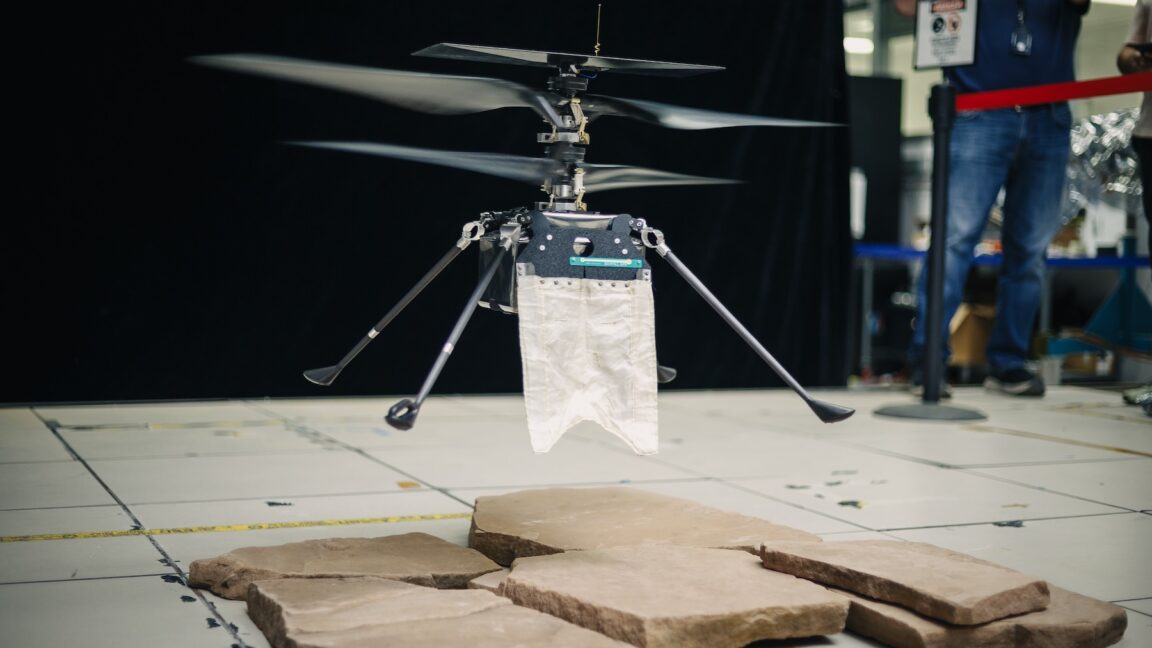
Developed by NASA’s Jet Propulsion Laboratory and AeroVironment, the SkyFall helicopters are an evolution of the experimental Ingenuity rotorcraft. Each unit will weigh approximately 2.5 kilograms and feature upgraded rotors capable of spinning at supersonic speeds to navigate the thin Martian atmosphere. Unlike Ingenuity, which relied on a rover for communications, SkyFall will transmit data directly through relay orbiters.
Autonomous Deployment and Science
The mission introduces the 'SkyFall maneuver,' a delivery method where the helicopters separate from the SR-1 Freedom spacecraft and land autonomously using a protective heat shield. Equipped with ground-penetrating radar, the drones will search for subsurface ice. While they lack the capacity for heavy instruments like drills or robotic arms, they are designed to operate as a repeatable product line for future exploration.
Changing Mars Program Priorities
The shift toward commercial partnerships and drone technology follows the cancellation of a costly Mars sample return mission. NASA is currently prioritizing lunar base development under the Trump administration, while seeking affordable, achievable goals for Mars. The agency is also pursuing commercial collaborations for orbiters and telecommunications networks to support ongoing surface operations.
Advertisement
This article was independently rewritten by ManyPress editorial AI from reporting originally published by Ars Technica.