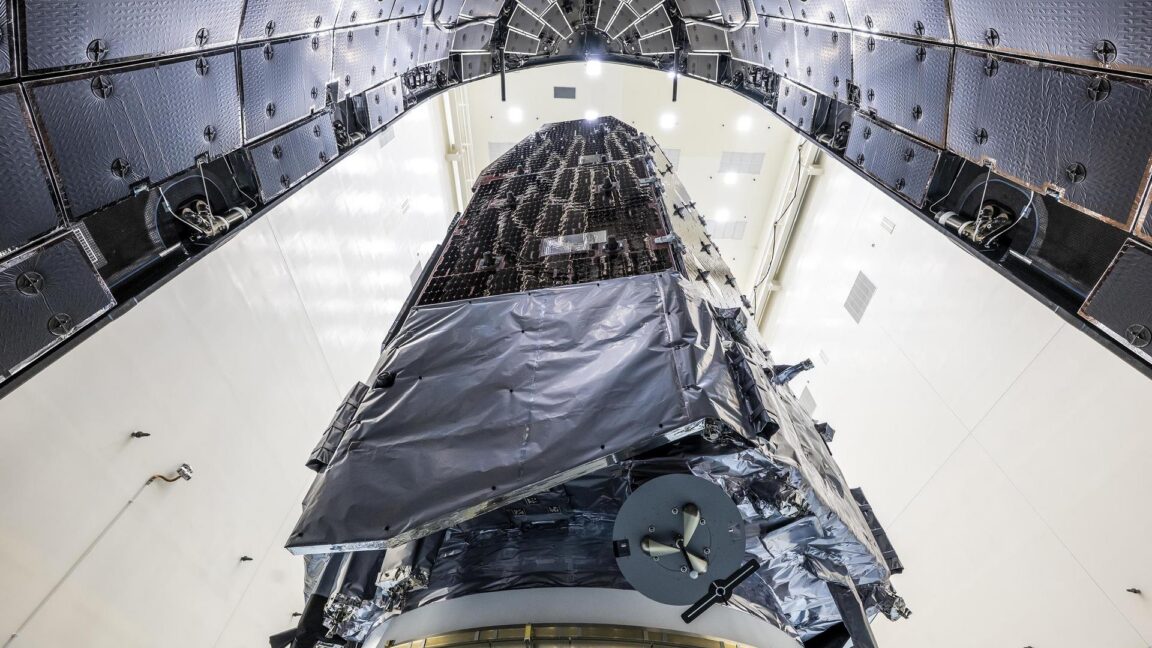
The Nancy Grace Roman Space Telescope has enough fuel for 22 years of operations, doubling initial expectations due to a precise launch and lower-than-projected spacecraft mass.
Key facts
- •The Roman Space Telescope launched on August 30 from Kennedy Space Center using a SpaceX Falcon Heavy rocket.
- •The spacecraft's final mass of 17,760 pounds was significantly lower than the 21,605-pound design maximum.
- •NASA officials confirmed the telescope now has enough fuel for at least 22 years of science operations.
- •The mission aims to measure dark energy and search for exoplanets from the L2 Lagrange point.
- •The telescope is the first NASA observatory built with a grapple fixture for potential future refueling.
NASA’s Nancy Grace Roman Space Telescope is on track for a 22-year lifespan, significantly exceeding its original 10-year design goal. Following its August 30 launch from Florida aboard a SpaceX Falcon Heavy rocket, the observatory performed a highly accurate course-correction maneuver that preserved critical fuel reserves. The telescope is currently traveling to the L2 Lagrange point, where it will conduct its mission to study dark energy and exoplanets.
By the numbers
Mass Savings and Fuel Efficiency
The extended mission duration is attributed to the spacecraft being lighter than its design specifications. While engineers initially budgeted for a maximum mass of 21,605 pounds, the final spacecraft weighed 17,760 pounds. This surplus mass allowed NASA to fill the propellant tanks to full capacity rather than limiting fuel to the 10-year requirement. Additionally, a three-minute engine burn shortly after launch achieved 99% accuracy, further conserving the telescope's fuel supply.
Mission Objectives and Capabilities
The $4.3 billion observatory is designed to provide images with the same resolution as the Hubble Space Telescope but with 100 times the field of view. Equipped with an 18-detector near-infrared instrument, the telescope will map galactic clusters and dark matter structures to investigate the nature of dark energy. Roman is also notable as the first NASA observatory specifically designed to support potential future in-space refueling missions.
Timeline
- August 30The Nancy Grace Roman Space Telescope launched from Kennedy Space Center.
- Within a day of launchThe telescope performed a three-minute engine burn to adjust its trajectory toward L2.
- MondayNASA confirmed the telescope has enough fuel for 22 years of operations.
Advertisement
This article was independently rewritten by ManyPress editorial AI from reporting originally published by Space.com, Ars Technica.