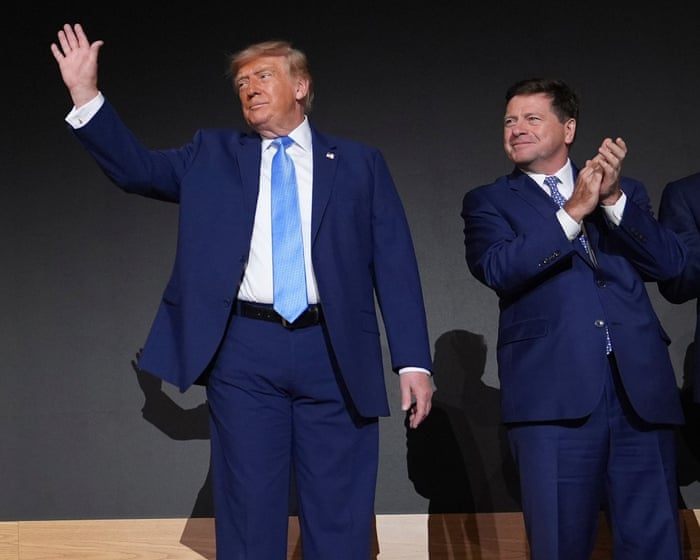
President Donald Trump has established a new task force to coordinate federal efforts regarding artificial intelligence, which he has rebranded as 'super intelligence.'

Key facts
- •President Trump announced the Super Intelligence Force on Truth Social, framing the technology as a development comparable to the Industrial Revolution.
- •The task force is required to submit a report on AI risks and opportunities within 120 days of its formation.
- •The administration has officially rebranded artificial intelligence as 'super intelligence' through a recent executive order.
- •The SIF will coordinate with private AI companies and critical infrastructure operators to protect American interests.
- •Jay Clayton, the Director of National Intelligence, will chair the task force, with support from several other federal agency heads.
President Donald Trump announced the creation of a new Super Intelligence Force (SIF) via a post on Truth Social. The task force is tasked with coordinating federal government efforts to ensure American leadership in the field of artificial intelligence, a term the administration has officially rebranded as 'super intelligence.' The unit will report directly to the president and his chief of staff, Susie Wiles.
Leadership and Structure
The Super Intelligence Force will be led by Director of National Intelligence Jay Clayton, who will serve as chair. According to reports, Federal Trade Commission Chair Andrew Ferguson, Undersecretary of War for Research and Engineering Emil Michael, and Office of Personnel Management Director Scott Kupor will serve as vice chairs. The task force is designed to coordinate outreach to various stakeholders, including AI companies, critical infrastructure operators, religious organizations, and consumer interest groups.
Objectives and Mandate
The charter for the task force outlines a mission to develop plans for responding to threats enabled by super intelligence while avoiding overregulation that could stifle innovation or competition. The group has been given a 120-day deadline to produce a report detailing the risks and opportunities associated with the technology. Jay Clayton has emphasized that a primary risk for the United States is failing to maintain a leading position in AI development compared to other nations.
Advertisement
This article was independently rewritten by ManyPress editorial AI from reporting originally published by TechCrunch, The Decoder.