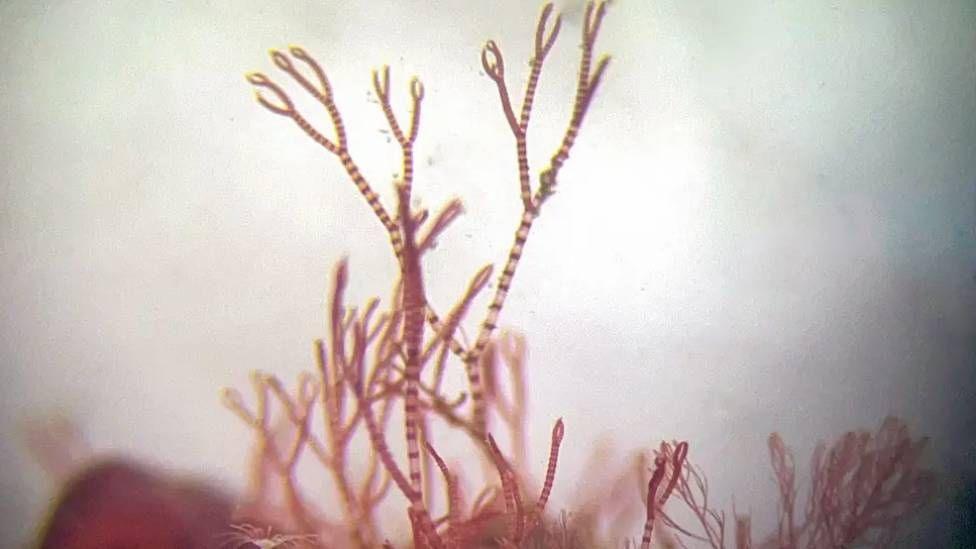
Prof Christine Maggs has confirmed a new species of pink-striped seaweed found in UK maerl beds, ending a four-decade scientific mystery.
Key facts
- •Prof Christine Maggs first encountered the seaweed fragment 40 years ago during her PhD studies.
- •The seaweed was identified using DNA sequencing with the assistance of Prof Beatriz de Barros Barreto.
- •The species will be scientifically named *Ceramium ruenessianum*.
- •The Natural History Museum has added a sample of the new species to its official collection.
- •Maerl beds are currently classified as a threatened and declining habitat under the OSPAR convention.
Prof Christine Maggs has officially identified a new species of seaweed, nicknamed the "pink-zebra weed," after a 40-year search. The tiny, pink-banded algae was discovered by researchers surveying maerl beds off the coast of Cornwall. The discovery, which involved DNA sequencing, has been added to the Natural History Museum's official collection and is set to be published in the journal Phycologia.
Discovery in Cornish Waters
The elusive seaweed was found by a team of scientific divers mapping and analyzing seaweeds to monitor the health of Cornish maerl beds, a project organized by Natural England. Freelance marine biologist Francis Bunker collected samples of the red algae, which features pincer tips and pink bands, and sent them to Prof Maggs for identification. To preserve the samples for DNA analysis, Prof Maggs utilized a wine fridge to maintain a dark, cool environment.
Scientific Significance and Protection
The new species, scientifically named Ceramium ruenessianum, highlights the biodiversity of maerl beds, which are rare, calcified seaweed habitats. While maerl beds are considered a threatened and declining habitat under the OSPAR convention, the specific beds off the south Cornish coast where this species was found lack formal protection. The Department for Environment, Farming and Rural Affairs stated that it must balance nature recovery with other priorities, such as fisheries and offshore wind development.
Timeline
- 40 years agoProf Christine Maggs first discovered a fragment of the unknown seaweed during her PhD.
- Two years agoResearchers surveying maerl beds in Cornwall found a sample of the seaweed.
- PresentThe species has been confirmed as new to science and added to the Natural History Museum collection.
Advertisement
This article was independently rewritten by ManyPress editorial AI from reporting originally published by BBC Science & Environment.