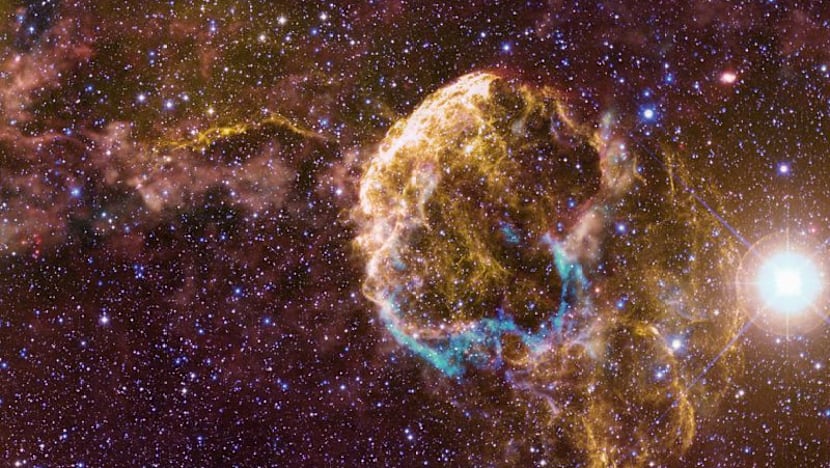
Researchers have discovered evidence of two massive stars from a single binary system that both exploded as supernovas, leaving behind distinct nebulas.
Key facts
- •The two nebulas are located about 6,000 light-years from Earth in the constellation Gemini.
- •The Jellyfish Nebula (IC 443) was produced by a star 15 to 25 times the mass of the sun.
- •The companion star, which created nebula G189.6+3.3, was at least 20 times the mass of the sun.
- •Researchers estimate 20,000 to 110,000 years passed between the two supernova explosions.
- •The study was published in the journal Nature Communications.
Scientists have identified the first known instance of a binary star system where both stars have exploded as supernovas and left behind observable remnants. Using 16 years of data from NASA's Fermi Gamma-ray Space Telescope, researchers linked the well-known Jellyfish Nebula to a newly identified nearby nebula. Both remnants are located approximately 6,000 light-years from Earth in the constellation Gemini.
By the numbers
Evolution of the Binary Pair
The Jellyfish Nebula, formally known as IC 443, originated from a star 15 to 25 times more massive than the sun. Its companion, which produced the nebula G189.6+3.3, was at least 20 times more massive than the sun. Researchers estimate that the first star exploded 20,000 to 110,000 years before its partner. The initial explosion disrupted the binary bond, causing the surviving star to move through space until it eventually exploded as well. During their existence, both stars were tens of thousands of times more luminous than the sun. While they once orbited in close proximity, the centers of the two resulting nebulas are now separated by 30 to 50 light-years. Both stars may have been reduced to dense neutron stars following their respective explosions.
Significance for Stellar Astrophysics
The discovery provides a rare opportunity to study the full evolutionary history of massive binary systems, which are common in the cosmos but difficult to observe in their final stages. Previously, scientists relied primarily on theoretical models and numerical simulations to understand how binary companions influence the life cycles of massive stars. Lead author Miltiadis Michailidis of Stanford University noted that the system allows researchers to observe how mass transfer and binary interactions modify stellar evolution. While it is unclear if the first explosion directly triggered the second, researchers believe the second star was likely nearing the end of its life cycle when the first supernova occurred.
Advertisement
This article was independently rewritten by ManyPress editorial AI from reporting originally published by Channel NewsAsia.