Astrophysicists have discovered that black holes release jets of material at specific points in their feeding cycle, regardless of their size.
Key facts
- •Black holes eject material back into space in the form of powerful jets and outflows after consuming stars.
- •The second phase of jet ejection occurs when a black hole's feeding rate falls to 2% of its maximum capacity.
- •Supermassive black holes and stellar-mass black holes exhibit the same jet-release behavior regardless of their size.
- •The findings allow scientists to narrow observation windows and improve the efficiency of telescope usage.
- •Radio frequencies are currently the only method for observing these jets as they move away from the black hole.
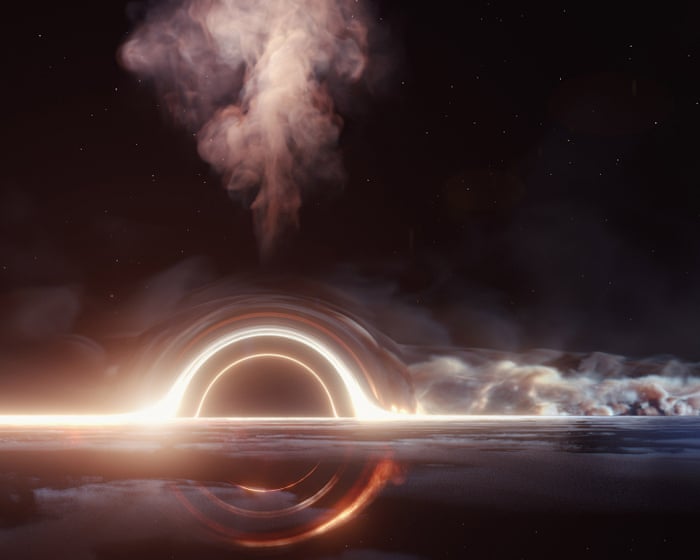
Researchers have identified the specific conditions under which black holes launch powerful jets of material back into space, a phenomenon described as a "burp." By studying how black holes interact with stars, scientists determined that these jets occur during two distinct phases of the feeding cycle. This discovery allows for more precise predictions of when these cosmic events will take place, potentially optimizing the use of telescope observation time.
By the numbers
The Mechanics of Cosmic Feeding
Black holes are characterized by an event horizon, a boundary from which light and matter cannot escape. While they are often viewed as cosmic sinkholes, astrophysicists describe them as "messy eaters." When a star wanders too close to a black hole, it undergoes a process called "spaghettification," where the star is stretched and torn apart. Only about half of the star's material is typically consumed by the black hole; the remainder is ejected into space as powerful jets that can influence the evolution of an entire galaxy.
Predicting Jet Ejection
The study found that both supermassive black holes—ranging from hundreds of thousands to billions of times the mass of the sun—and smaller stellar-mass black holes release jets at the same point in their feeding cycle. The first phase occurs during high-rate feeding, while the second happens hundreds to thousands of days after the star is destroyed. This second phase triggers when the feeding rate drops to approximately 2% of the black hole's maximum swallowing capacity. Because radio frequencies allow scientists to observe these jets as they move outward, this consistent threshold provides a reliable window for future astronomical study.
Advertisement
This article was independently rewritten by ManyPress editorial AI from reporting originally published by Guardian Science.