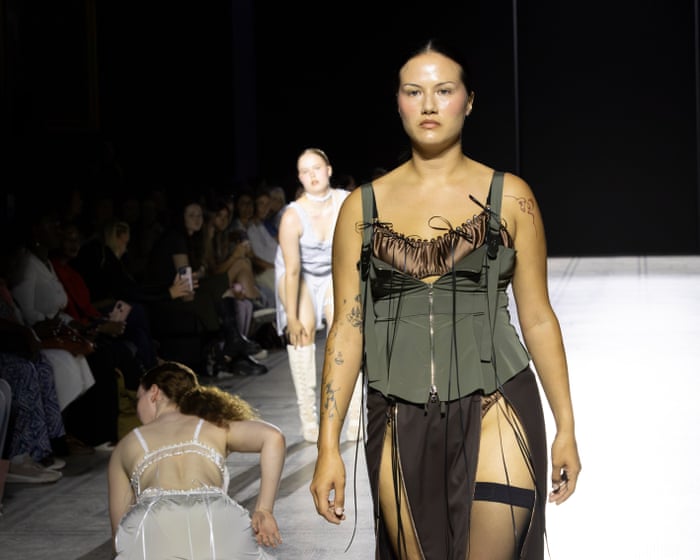
Designer Sinéad O’Dwyer showcased a diverse range of body types at the Victoria and Albert Museum, challenging the fashion industry's focus on thinness.
Key facts
- •The Vogue Business Size Inclusivity Report found that 97.6% of models for autumn/winter 2026 were UK size 4-8.
- •Sinéad O’Dwyer uses a UK size 18 for her catwalk samples, contrasting with the industry standard of size 4-8.
- •A Vogue Business survey reported that 68% of plus-size respondents feel alienated by the fashion industry.
- •London Fashion Week remains the fashion week that features the most body diversity, though 92.7% of models there are still straight-size.
- •The average clothing size in the UK is 16.
Designer Sinéad O’Dwyer presented her Fashion in Motion show at London’s Victoria and Albert Museum on Friday. The event featured a cast of performers and models of various sizes, moving away from the industry standard of using thin models. Unlike many exclusive fashion events, the show was open to the public with tickets priced at £5.
By the numbers
Challenging Industry Standards
Since her debut at London Fashion Week in 2021, O’Dwyer has consistently pushed against the industry's preference for thin body types. While most luxury brands create sample garments based on a UK size 4-8, O’Dwyer uses a size 18. She argues that her inclusive approach is more appropriate for the general public than the traditional luxury fashion system, which she suggests does not aim to include everyone.
The State of Inclusivity
Despite some progress in recent years, industry experts note that inclusivity efforts have stalled. According to the Vogue Business Size Inclusivity Report, 97.6% of models for the autumn/winter 2026 season were 'straight-size' (UK 4-8). Stylist Jeanie Annan-Lewin and casting director Emma Matell attribute this trend to a broader societal shift, noting that the industry appears to be returning to a preference for women to take up less space. Additionally, the rise of GLP-1 weight-loss drugs has contributed to a renewed reverence for thinness.
Economic and Social Impact
Experts emphasize that the industry's focus on thinness may be a missed commercial opportunity. Research from Vogue Business indicates that 68% of plus-size respondents feel alienated by the fashion industry, despite their potential spending power. O’Dwyer and other advocates argue that financial support is necessary for brands to overcome the high costs of changing manufacturing methods to accommodate diverse sizes.
Advertisement
This article was independently rewritten by ManyPress editorial AI from reporting originally published by The Guardian Fashion.
.jpeg)