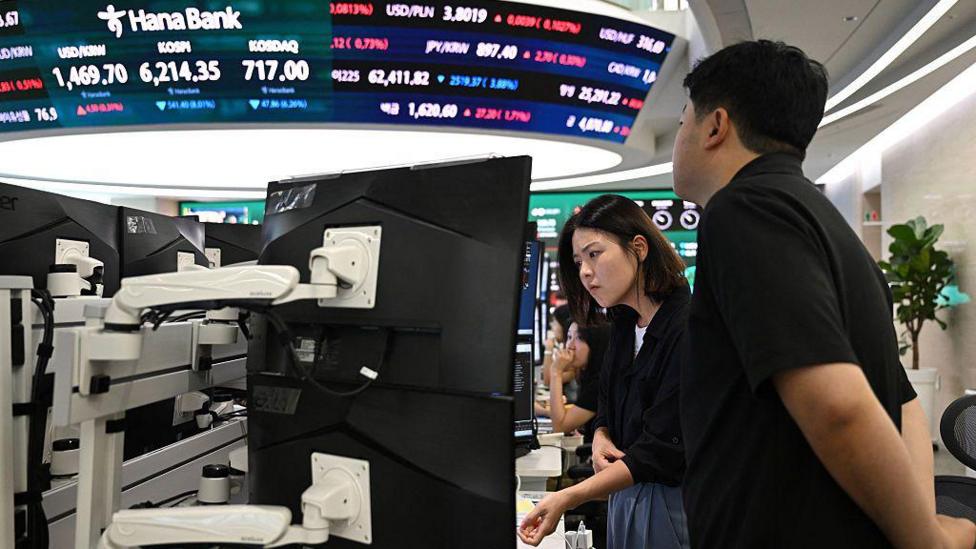
South Korean chipmaker SK hynix is preparing to raise approximately $28 billion on Wall Street through a Nasdaq listing. This move follows a significant valuation increase and aims to fund new fabrication plants.
Key facts
- •SK hynix is preparing to raise approximately $28 billion on Wall Street through a Nasdaq listing.
- •The listing involves 17.79 million new shares issued as American depositary receipts (ADRs).
- •Cornerstone investors have signaled interest in up to $7 billion worth of stock.
- •The company's valuation has surpassed $1 trillion after a surge of over 200% this year.
- •Proceeds will fund new fabrication plants in Yongin and a US packaging facility in Indiana.
- •SK hynix commands about 60% of the high-bandwidth memory (HBM) market.
SK hynix, a South Korean chipmaker known for high-bandwidth memory chips, is preparing to raise roughly $28 billion on Wall Street. The pricing for its Nasdaq listing is due on Thursday, with trading expected to begin on Friday under the ticker SKHY. This extraordinary outcome follows a period where the firm once survived on job cuts and asset sales, and its current valuation has surpassed $1 trillion.
By the numbers
Nasdaq Listing Details
SK hynix is issuing 17.79 million new shares in the form of American depositary receipts (ADRs), each representing a tenth of a Seoul-listed share. Cornerstone investors, including Baillie Gifford and funds managed by Coatue Management, have indicated interest in up to $7 billion worth of stock. The target amount for the raise was trimmed from an initial $29.6 billion after recent share slips. This Nasdaq offering is not SK hynix's stock market debut, as its primary listing remains on Seoul's Kospi index; it provides a second, dollar-denominated avenue for investors.
Company Transformation and Growth
The company's journey began as Gukdo Construction in 1949, moving into electronics in 1983 as Hyundai Electronics. It faced disaster during the Asian financial crisis of the late 1990s, leading to job cuts and asset sales after being renamed Hynix Semiconductor in 2001. In 2012, the telecoms conglomerate SK Group rescued the firm, investing in high-bandwidth memory (HBM), which was then a costly and unprofitable technology. This investment proved decisive, as HBM has become a scarce commodity in AI computing, and the company's valuation has surged over 200% this year to more than $1 trillion.
Market Context and Financial Performance
The AI build-out has transformed the industry's economics, with hyperscalers investing hundreds of billions into data centers, causing memory prices to explode. DRAM prices are up 44% and NAND flash up 53% in a single quarter, according to Citi Research, and manufacturers have already sold most of their 2026 production. SK hynix reported first-quarter revenue above 50 trillion won and operating margins north of 70%, and commands about 60% of the HBM market, according to Counterpoint Research. Proceeds from the listing will fund new fabrication plants, including a large cluster in Yongin, and its first US packaging facility in Indiana. The move also aims to close the valuation gap between Korean-listed chipmakers and their American peers.
Timeline
- 1949Gukdo Construction, the company's root, was founded.
- 1983The company moved into electronics as Hyundai Electronics.
- late 1990sThe Asian financial crisis led to disaster for the firm.
- 2001The firm was renamed Hynix Semiconductor.
- 2012The company was rescued by SK Group, becoming SK hynix.
- last monthSpaceX's record flotation occurred, a sum surpassed only by SK hynix's raise.
- late JuneThe Bank for International Settlements warned about the AI boom's potential to seed a financial crash.
- this yearSK hynix's valuation surged more than 200%.
Advertisement
This article was independently rewritten by ManyPress editorial AI from reporting originally published by Euronews Business.