Artificial gravity could mitigate the health risks of microgravity, but researchers face significant hurdles in implementation, funding, and determining the optimal design.
Key facts
- •Microgravity exposure during spaceflight causes health issues including bone loss, muscle atrophy, and fluid shifts in the eyes.
- •The Centrifuge Accommodation Module, a planned 8.2-foot-wide device for the ISS, was canceled in 2005 due to budget constraints.
- •Short-radius centrifuges with a 6 to 10-foot radius are considered the most feasible option for near-term implementation.
- •Training in a centrifuge can help humans acclimate to rotation and mitigate the Coriolis cross-coupled illusion.
- •Research using head-down tilt bed rest indicates that 30 minutes of daily centrifuge use may prevent some muscle function loss.
Extended exposure to microgravity during long-haul spaceflight poses significant health risks, including muscle and bone loss, vision changes, and blood clots. Researchers are exploring artificial gravity as a potential solution, though the technology remains largely theoretical. Experts suggest that while the engineering principles are understood, the primary barriers to implementation are budgetary constraints and a lack of consensus on the most effective methods for simulating Earth-like forces.
By the numbers
Proposed Methods for Artificial Gravity
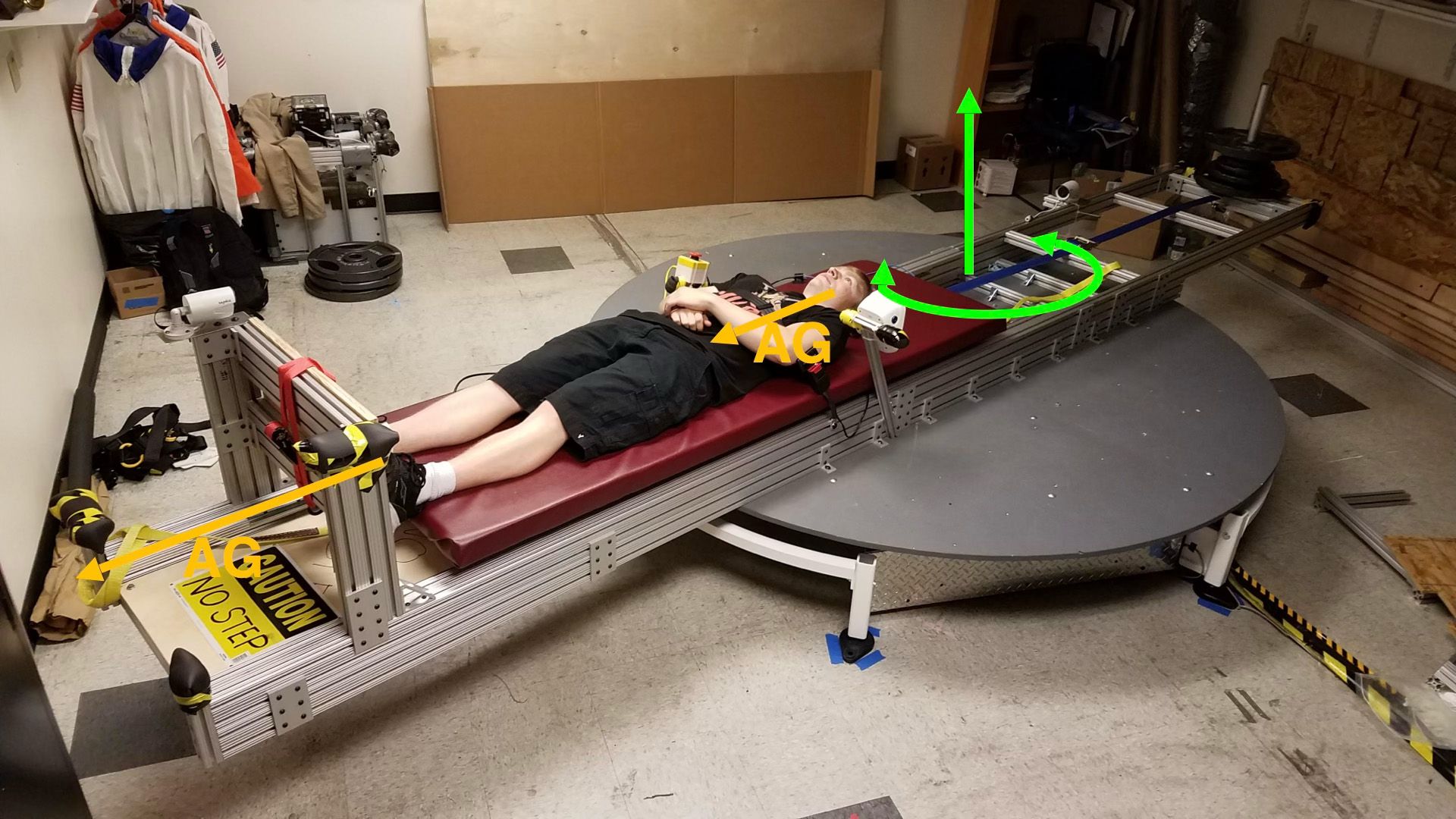
There are three primary approaches to generating artificial gravity in space. The first involves a large rotating ring that spins the entire living quarters, allowing passengers to live under constant gravity. While effective, this requires massive infrastructure and assembly in space. A second, more feasible option is a short-radius centrifuge, a device with a 6 to 10-foot radius that functions like an exercise machine, where occupants spend short daily sessions to experience gravitational pull. The third method involves linear acceleration, where a spacecraft continuously accelerates to push occupants toward the floor. However, this requires advanced propulsion technology capable of constant acceleration, which is currently unavailable. Each method presents unique engineering challenges, ranging from the massive scale of rotating rings to the motion sickness induced by the fast spin of smaller centrifuges.
Human Factors and Implementation
A significant concern with short-radius centrifuges is the Coriolis cross-coupled illusion, which causes motion sickness when a person tilts their head while rotating. Research led by Torin Clark suggests that humans can build a tolerance to this sensation through incremental training over multiple days, potentially allowing for spin rates up to 20 to 30 rotations per minute. Despite this, researchers remain uncertain about the exact duration and intensity of gravity required to counteract the physiological effects of spaceflight. Previous attempts to implement artificial gravity, such as the 8.2-foot-wide Centrifuge Accommodation Module for the International Space Station, were canceled due to budget issues. Experts note that the field experiences cycles of high interest and funding followed by periods of stagnation. Currently, the scientific community lacks a definitive answer on whether short daily sessions, such as 30 minutes to two hours, are sufficient to prevent the deconditioning associated with long-term space travel.
Timeline
- 1968The film '2001: A Space Odyssey' popularized the concept of a giant rotating ring for artificial gravity.
- 2005The Centrifuge Accommodation Module project for the International Space Station was canceled.
- 2006Astronaut Sunita Williams exercised on the Treadmill Vibration Isolation System aboard the ISS.
Advertisement
This article was independently rewritten by ManyPress editorial AI from reporting originally published by Live Science.