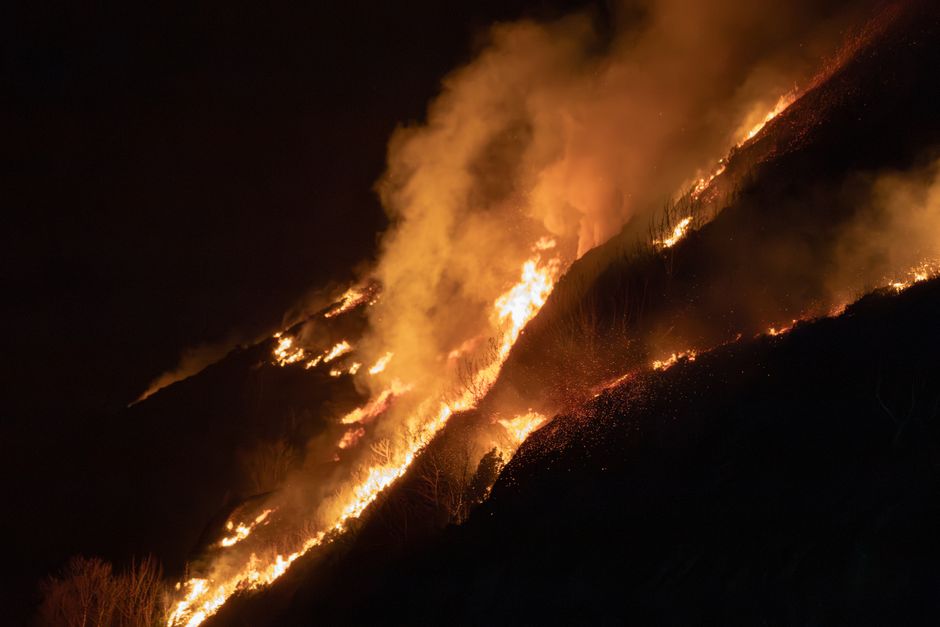
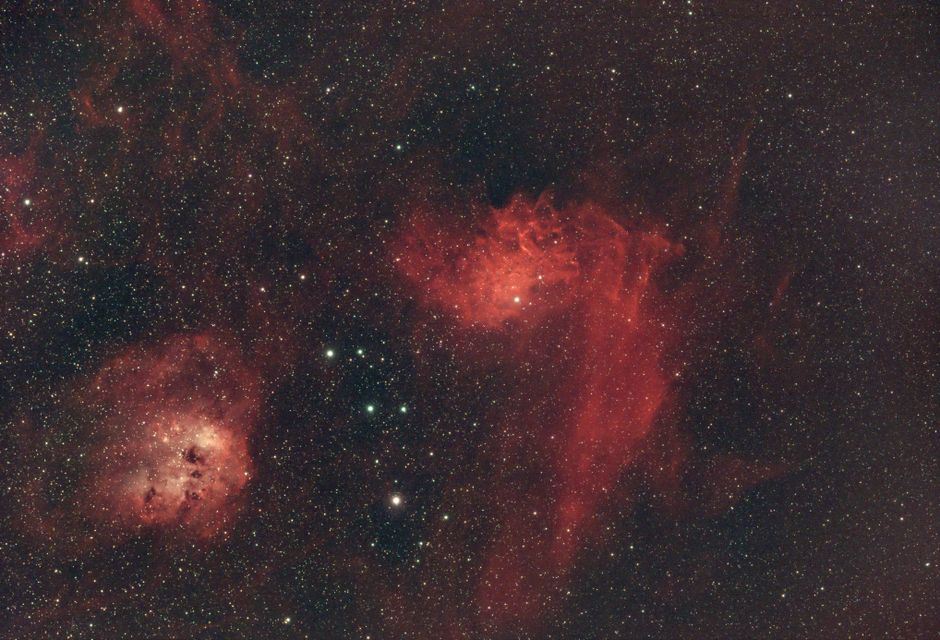
NASA's Hubble Space Telescope has captured a stunning image of a stellar nursery, showcasing blue and white stars against a crimson background.
Key facts
- •NGC 6426 is a 13 billion-year-old globular cluster in the Milky Way.
- •The cluster has low metallicity, with stars containing small amounts of elements heavier than hydrogen and helium.
- •LH 95 is a star-forming region in the Large Magellanic Cloud.
- •The region contains thousands of developing stars, including pre-main-sequence stars.
- •Hubble's observations reveal the formation of new stars in LH 95.
- •The stars in NGC 6426 are estimated to have formed not long after the universe came into existence.
A new image from NASA's Hubble Space Telescope reveals a brilliant field of red, white, and blue stars, resembling a sparkler glowing against the night sky. The image features two different stellar systems: NGC 6426, a globular cluster, and LH 95, a star-forming region. NGC 6426 is estimated to be around 13 billion years old, making it one of the oldest globular clusters in the Milky Way.
By the numbers
NGC 6426 Globular Cluster
NGC 6426 is a dense, spherical swarm of stars that remains bound together by gravity. The cluster is estimated to be around 13 billion years old, making it a valuable record of conditions in the early universe. The stars in NGC 6426 have low metallicity, meaning they contain relatively small amounts of elements heavier than hydrogen and helium. Scientists have also found evidence that the cluster contains two chemically distinct populations of stars.
LH 95 Star-Forming Region
LH 95 is a vast star-forming region inside the Large Magellanic Cloud, a dwarf galaxy that orbits the Milky Way. The region contains both newly forming low-mass stars and massive blue giants. The brightest blue stars in LH 95 are also its most powerful, flooding the surrounding region with intense ultraviolet radiation and blasting out powerful stellar winds. Hubble's observations reveal thousands of developing stars that are still drawing in material from the surrounding disks of gas and dust.
This article was independently rewritten by ManyPress editorial AI from reporting originally published by ScienceDaily, ScienceDaily.