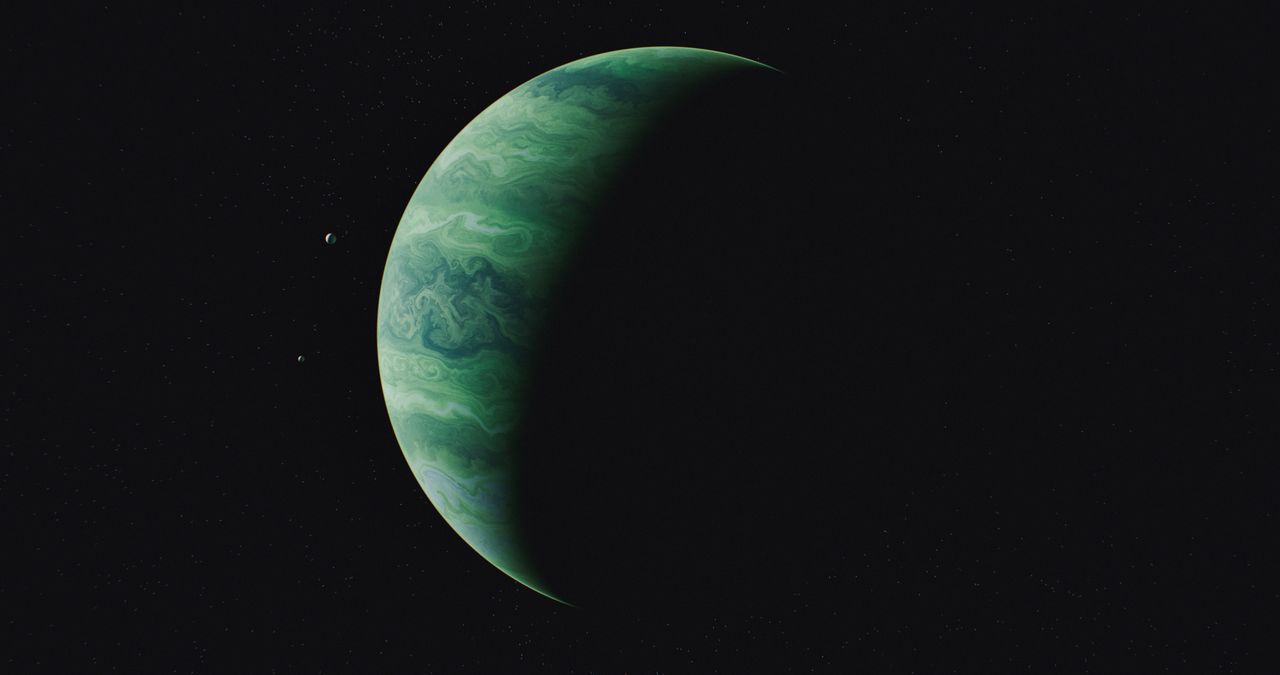
Researchers have identified Elias 2-24 b, a Jupiter-mass planet less than a million years old, challenging existing theories on how giant planets form.
Key facts
- •Elias 2-24 b is less than one million years old, making it the youngest exoplanet confirmed to date.
- •The planet is approximately the mass of Jupiter and orbits a star located 450 light-years from Earth.
- •The discovery was made by analyzing archival data from the W. M. Keck Observatory in Hawaii.
- •Previous record-holding planets were all at least five million years old.
- •The planet is located 55 times farther from its host star than Earth is from the sun.
Astronomers have confirmed the discovery of the youngest exoplanet ever detected, a world less than one million years old named Elias 2-24 b. The planet, which is approximately the mass of Jupiter, was identified using archival data from the W. M. Keck Observatory in Hawaii. It remains embedded within its natal disk of gas and dust, providing researchers with a rare opportunity to observe planetary formation in its earliest stages.
By the numbers
Challenging Formation Models
Current planet-formation models previously struggled to explain the existence of planets younger than five million years. Elias 2-24 b, located about 450 light-years from Earth, exists in a gap within its host star's disk, supporting the theory that planets carve out these spaces as they form. However, the planet's location—55 times farther from its star than Earth is from the sun—defies predictions that such large planets require significantly more time to form at that distance.
Verification Through Archival Data
The discovery resolves a decade-long mystery that began when the Atacama Large Millimeter/submillimeter Array (ALMA) first detected a gap in the star's disk. A team led by Andrea Bernardi of the Universidad Diego Portales confirmed the planet by analyzing archival observations from the Keck Observatory taken in 2018 and 2020. By tracking the object's motion over time, researchers confirmed it was a planet rather than an imaging artifact.
Timeline
- About a decade agoALMA observations identified a gap in the dusty disk surrounding the star Elias 2-24.
- 2018 and 2020Researchers captured observations of the planet using the W. M. Keck Observatory.
- August 30NASA's Nancy Grace Roman Space Telescope launched, which is expected to aid future planet detection.
Advertisement
This article was independently rewritten by ManyPress editorial AI from reporting originally published by Phys.org.