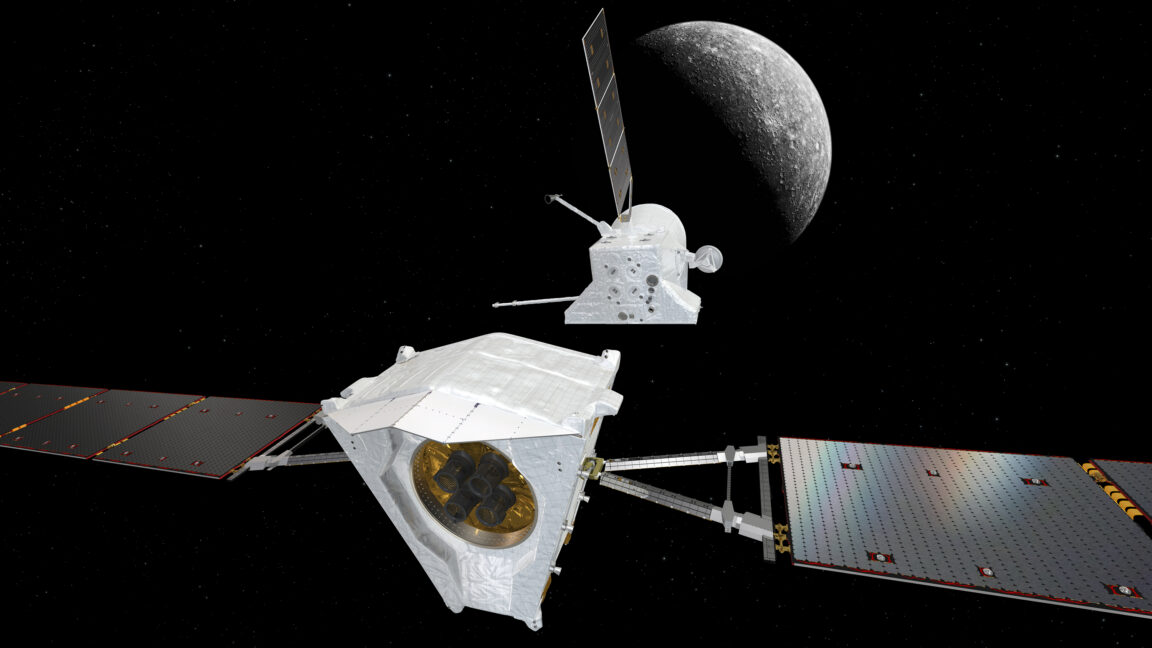
The BepiColombo spacecraft has jettisoned its propulsion module as it prepares to enter orbit around Mercury in November.
Key facts
- •The BepiColombo mission has a total cost of nearly $2 billion.
- •The spacecraft launched in 2018 and has traveled more than 6 billion miles to reach Mercury.
- •Engineers extended the mission by one year after the ion thrusters experienced partial power loss in 2024.
- •The mission utilizes nine planetary flybys to manage the energy required to enter Mercury's orbit.
- •Routine scientific observations are scheduled to commence in April 2026.
The BepiColombo mission, a joint effort led by the European Space Agency with contributions from Japan and the United States, has reached a critical milestone in its eight-year voyage to Mercury. On Thursday, the spacecraft successfully jettisoned its Mercury Transfer Module, a necessary step before it attempts to enter orbit around the planet on November 21. The mission, which has traveled over 6 billion miles, aims to study Mercury using two separate orbiters.
By the numbers
Spacecraft separation and arrival
BepiColombo consists of three stacked components: the Mercury Transfer Module, the European-built Mercury Planetary Orbiter, and Japan’s Mercury Magnetospheric Orbiter, known as Mio. The transfer module provided power and propulsion during the cruise but was discarded to allow the remaining orbiters to function independently. The separation occurred 39 million miles from the Sun, a maneuver described by mission officials as high-risk due to the extreme solar radiation and heat. Following the separation, telemetry confirmed that the Mercury Planetary Orbiter’s solar arrays are generating power and recharging batteries. The two remaining orbiters are scheduled to release from one another in December after reaching their initial orbit, with routine scientific observations expected to begin in April 2026.
Mission goals and scientific objectives
The mission is designed to provide high-resolution mapping and study the planet's surface, magnetic fields, plasma, and dust. While the European orbiter will focus on the surface, the Japanese orbiter will operate in a higher orbit to monitor the environment. Scientists hope to investigate the composition of Mercury, including the potential presence of water ice in crater floors at the poles, and better understand the impact of solar wind on the planet.
Timeline
- 2018BepiColombo launched from Earth.
- January 8, 2025The transfer module camera captured an image of Mercury's surface during a flyby.
- ThursdayThe Mercury Transfer Module was successfully jettisoned.
- November 21The spacecraft is scheduled to maneuver into orbit around Mercury.
- DecemberThe European and Japanese orbiters will release from one another.
- April 2026Routine science observations are expected to begin.
Advertisement
This article was independently rewritten by ManyPress editorial AI from reporting originally published by Ars Technica.