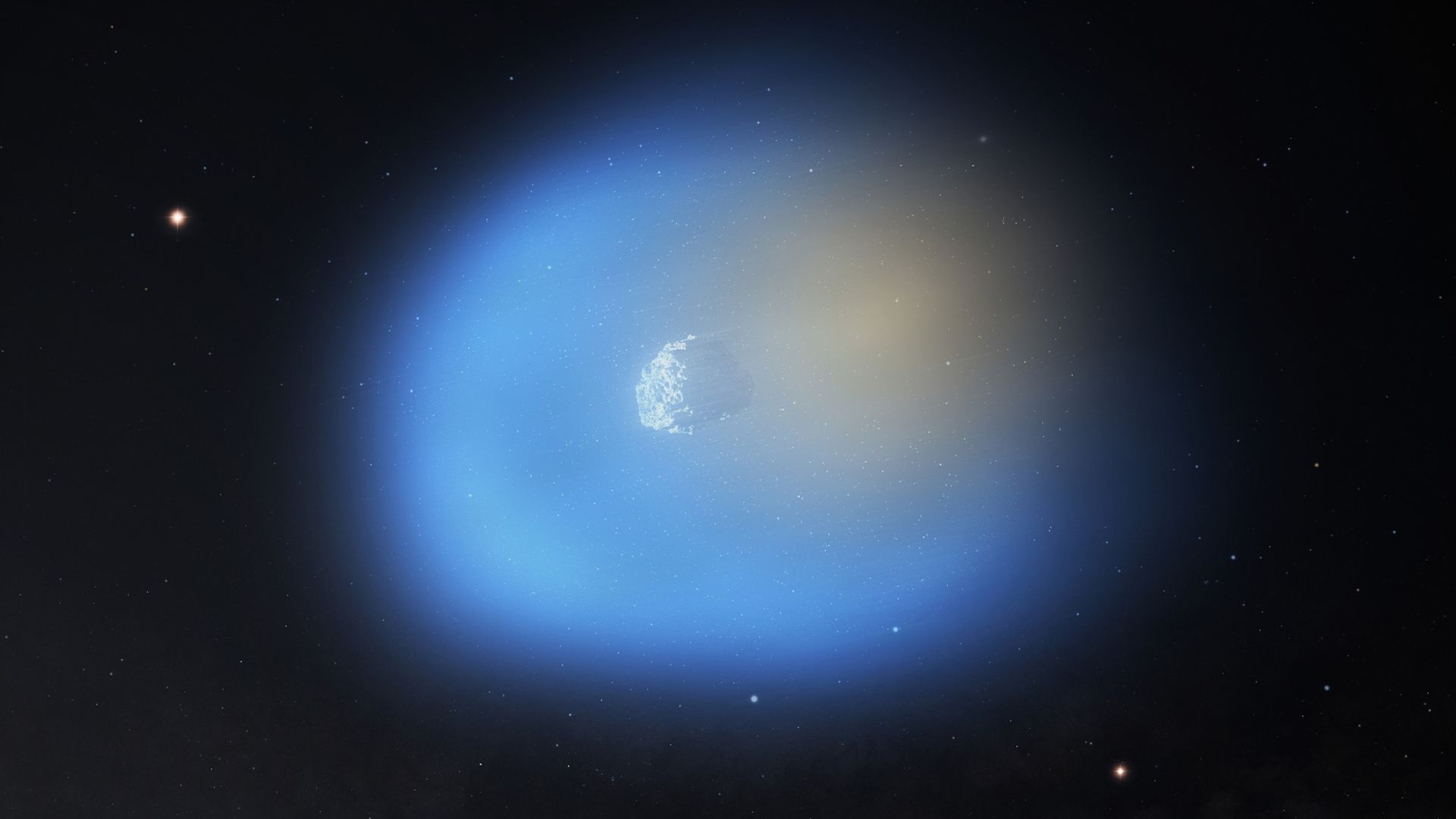
Scientists are studying the interstellar comet 3I/ATLAS to understand if the chemical ingredients for life are common throughout the galaxy.
Key facts
- •3I/ATLAS is considered a preserved fragment of a planetesimal from a distant star system.
- •The comet released organic compounds including hydrogen cyanide, formaldehyde, methanol, and methane.
- •Methane detected by the James Webb Space Telescope could have potentially warmed planets in the comet's home system.
- •Researchers had nearly a year to study 3I/ATLAS, providing a more detailed chemical inventory than for previous interstellar visitors.
- •The Vera C. Rubin Observatory is expected to identify dozens of future interstellar objects.
In July 2025, the interstellar comet 3I/ATLAS entered our solar system, remaining observable for nearly a year. As the third interstellar object ever discovered, it provided astronomers with a unique opportunity to analyze the chemical composition of a body originating from a distant planetary system.
Chemical Composition and Life's Origins
Observations using ground-based and space telescopes, including the James Webb Space Telescope and ALMA, revealed that 3I/ATLAS contains organic molecules such as hydrogen cyanide, formaldehyde, methanol, and methane. Researchers note that these compounds are essential feedstocks for prebiotic chemistry, potentially serving as the building blocks for proteins and nucleic acids.
Significance of Interstellar Observations
Unlike previous interstellar objects like 1I/'Oumuamua and 2I/Borisov, which had limited observation windows, 3I/ATLAS allowed for a more comprehensive chemical inventory. Scientists believe studying such objects helps determine if distant planetary systems possess the necessary materials to support life, similar to how asteroids like Bennu transported life-essential molecules within our own solar system.
Limitations and Future Research
While the presence of these chemicals is significant, researchers caution that they have not found complex molecules on the comet. Additionally, a January study suggested that the detected chemicals may originate from the comet's outer layers rather than its pristine interior. Astronomers expect the Vera C. Rubin Observatory in Chile to detect more interstellar objects, aiding in the creation of a broader map of bio-precursor distribution across the galaxy.
Timeline
- July 2025The interstellar comet 3I/ATLAS visited the inner solar system.
- JanuaryA study found that most chemicals released by the comet likely came from its radiation-exposed upper layers.
- Early 2026NASA's SPHEREx telescope detected organic compounds on the comet.
Advertisement
This article was independently rewritten by ManyPress editorial AI from reporting originally published by Live Science.