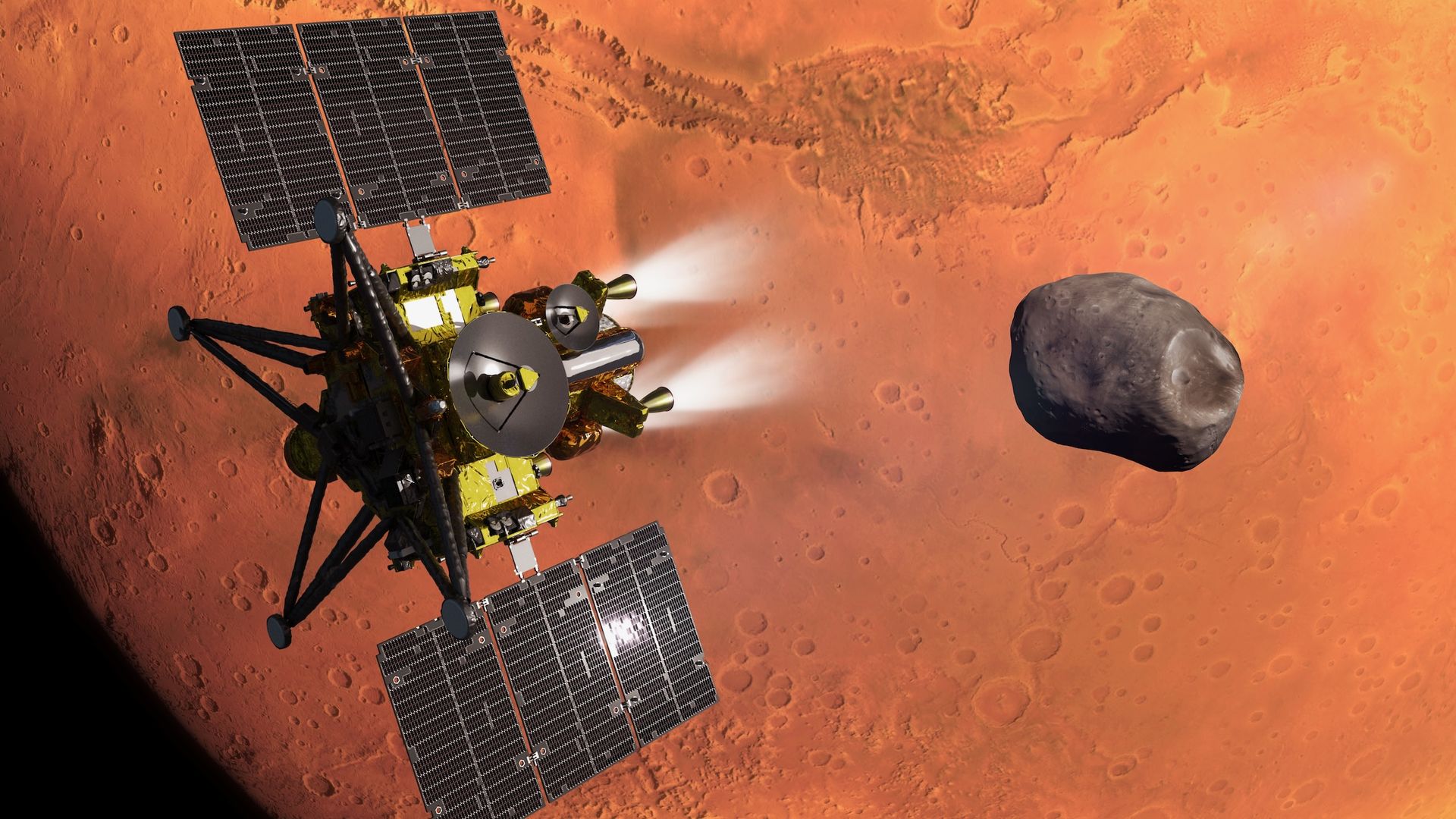
The Japan Aerospace Exploration Agency has launched the Martian Moons eXploration mission, which aims to collect and return surface samples from the moon Phobos.
Key facts
- •The MMX spacecraft is a collaborative project involving JAXA, NASA, and European space agencies.
- •Phobos is approximately 14 miles wide, while Deimos is about 8 miles in diameter.
- •The mission includes the deployment of the 55-pound Idefix rover to study the surface of Phobos.
- •Data from the mission is intended to support future human exploration by assessing the potential of Phobos as a natural space station.
- •NASA is contributing a scientific instrument, technology demonstration, communication support, and funding for American researchers.
Japan has launched the Martian Moons eXploration (MMX) mission, an international effort to study Mars' moons, Phobos and Deimos. The spacecraft lifted off atop an H3 rocket from the Tanegashima Space Center. The mission seeks to determine the origins of the two moons, which remain a subject of scientific debate, and to collect surface material for return to Earth.
By the numbers
Scientific Goals and Origins
The MMX mission aims to resolve the mystery of how Phobos and Deimos formed. Scientists are currently weighing two primary theories: that the moons are ancient asteroids captured by Mars' gravity, or that they are the result of a massive impact on Mars that sent debris into orbit. Understanding their origin is expected to provide insights into the early history of the solar system and the development of habitable environments on terrestrial planets.
Mission Timeline and Operations
The spacecraft is scheduled to arrive in the Mars system in August 2027. After orbiting Phobos and Deimos, the mission plans to deploy the French-German Idefix rover onto the surface of Phobos in early 2029. The rover will analyze surface composition and texture to prepare for the main spacecraft's landing, which intends to collect at least 10 grams of material. The probe is expected to spend approximately three years in the vicinity of Mars.
Advertisement