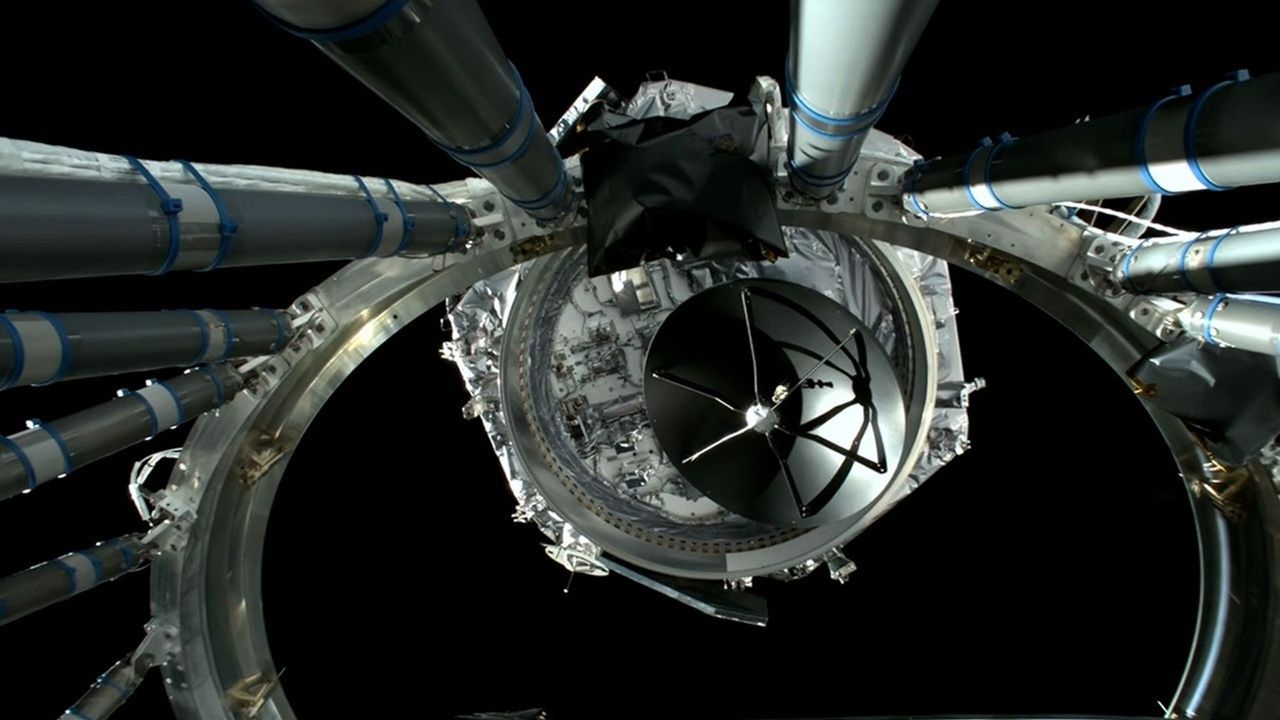
NASA has initiated the commissioning process for the Nancy Grace Roman Space Telescope, successfully activating its primary scientific instruments during its transit to Lagrange point two.
Key facts
- •The Nancy Grace Roman Space Telescope launched on August 30 and is traveling to Lagrange point two (L2).
- •The Wide Field Instrument uses 18 infrared detectors that provide a sensing area roughly the size of a laptop.
- •Engineers confirmed the WFI's focus components were functioning nominally on the morning of September 13.
- •The coronagraph is being commissioned by the Coronagraph Commanding Center at Caltech/IPAC in Pasadena, California.
- •NASA expects the telescope to have enough fuel to support 22 years of operations.
NASA has begun switching on the instruments of the Nancy Grace Roman Space Telescope as the spacecraft travels toward Lagrange point two (L2). Launched on August 30, the telescope is currently on a three-month journey to its destination, located nearly a million miles from Earth. While the instruments are not yet ready for scientific data collection, initial downlinks confirm that components are functioning nominally as commissioning efforts continue.
By the numbers
Wide Field Instrument Activation
The Wide Field Instrument (WFI), a 300-megapixel infrared camera, underwent a 10-day decontamination process to shed potential contaminants before activation. On September 11, engineers turned off the instrument's heater, allowing it to cool to -225 degrees Fahrenheit, the temperature required to activate its 18 infrared detectors. Following this, teams calibrated the WFI's element wheel and confirmed on September 13 that the focus components were operating as expected. The WFI is designed to survey large areas of the sky to study dark energy and map matter distribution.
Coronagraph Instrument Testing
The telescope's Coronagraph Instrument also completed its initial operational milestones. Operators at the Coronagraph Commanding Center at Caltech/IPAC verified they could remotely control the instrument's mechanical and electronic systems. The coronagraph uses mirrors and masks to block starlight, enabling the detection of fainter light from orbiting planets. Testing included warming the device to 72 degrees Fahrenheit to simulate Earth-based test conditions, allowing engineers to calibrate the instrument's deformable mirrors.
Mission Timeline and Longevity
Decontamination procedures for the coronagraph will continue for 30 days, while the entire observatory continues its transit to L2, expected to take approximately 12 more weeks. NASA reports that the telescope remains on schedule to release its first science images in early 2027. Due to fuel savings from trajectory corrections and the precision of the SpaceX Falcon Heavy launch, the mission is expected to have sufficient propellant to operate for 22 years.
Timeline
- August 30The Nancy Grace Roman Space Telescope launched.
- September 11Teams turned off the WFI heater to begin cooling the instrument for detector activation.
- September 13Roman teams confirmed the WFI focus components were functioning nominally.
Advertisement
This article was independently rewritten by ManyPress editorial AI from reporting originally published by Space.com.