A discarded SpaceX Falcon 9 rocket stage is on a collision course with the Moon, providing a rare opportunity for scientists to study lunar impact effects.
Key facts
- •The rocket stage is traveling at approximately 5,400 mph (2.43 km/s).
- •The impact is not visible to the naked eye but may be seen with sophisticated telescopes.
- •NASA will track the booster and observe the impact site for scientific purposes.
- •A previous lunar impact involving a Chinese Long March 3C rocket occurred in 2022.
- •The event is not considered dangerous to Earth.
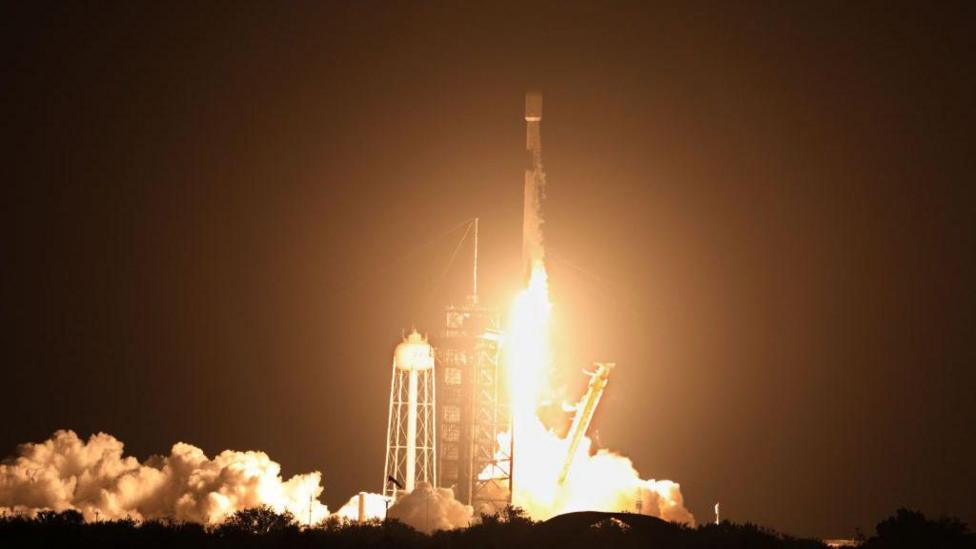
A portion of a SpaceX Falcon 9 rocket is expected to collide with the Moon on Wednesday, August 5. According to NASA's Centre for Near-Earth Object Studies, the upper stage of the rocket, which was launched in January 2025, is traveling at approximately 2.43 kilometers per second. The impact is predicted to occur at 02:35 EDT (06:35 GMT).
By the numbers
Scientific Opportunity and Observation
Astronomers intend to use the collision as an experiment to better understand lunar impacts. The event is expected to create a significant plume of dust, potentially reaching 50 kilometers or more into the air. Because the Moon lacks an atmosphere, the debris will not be slowed down, allowing scientists to observe how material is ejected and how it settles. Researchers plan to monitor the event using major telescopes in the Americas, NASA's Lunar Reconnaissance Orbiter, and South Korea's Danuri probe. By analyzing the plume and the resulting crater, scientists hope to gain insights into the composition of the lunar subsurface.
Space Debris Concerns
The collision highlights the growing issue of human-made space debris. According to the European Space Agency, there are approximately 54,000 objects larger than 10 centimeters currently in space. Since the beginning of the Space Age in 1957, humans have launched an estimated 17,000 tonnes of material into orbit, raising concerns among experts about the potential for a runaway cascade of collisions.
Timeline
- 1957The Space Age began, marking the start of human launches into space.
- January 2025The SpaceX Falcon 9 rocket was launched.
- August 5The rocket stage is expected to impact the Moon at 02:35 EDT.
Advertisement
This article was independently rewritten by ManyPress editorial AI from reporting originally published by BBC Science & Environment.