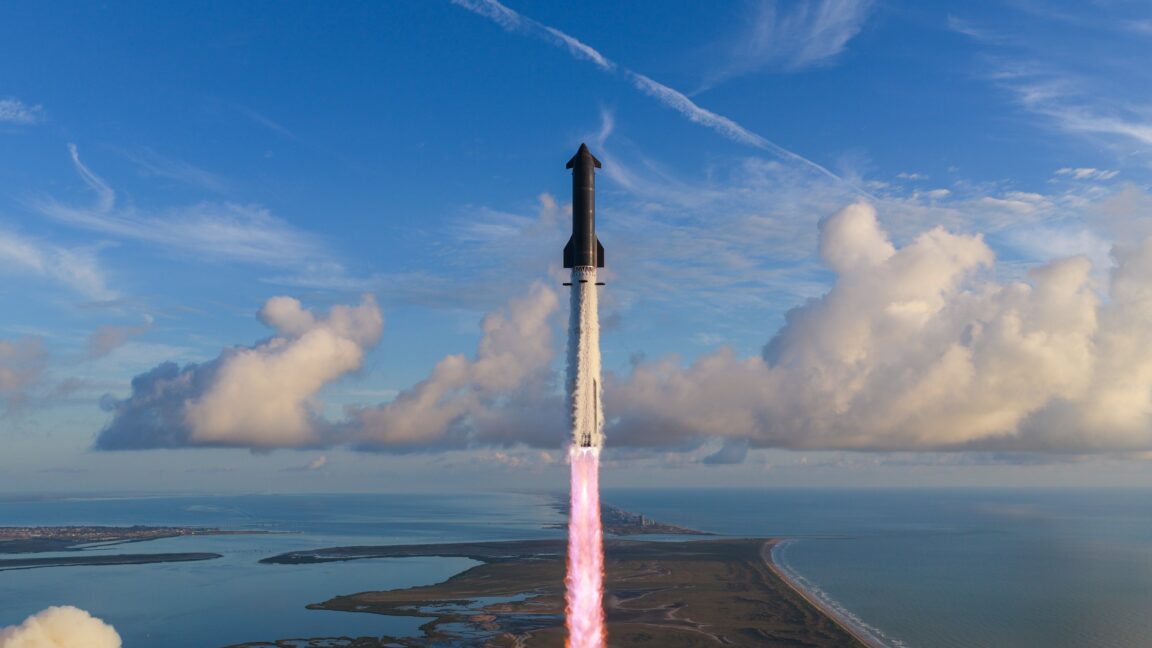
SpaceX successfully launched its Starship rocket into orbit for the first time, deploying 26 next-generation Starlink satellites before a final splashdown.
Key facts
- •The 14th Starship test flight launched from Starbase, Texas, on Monday, September 28.
- •The rocket reached a peak altitude of 170 miles (275 kilometers) above Earth.
- •SpaceX deployed 26 Starlink V3 satellites, which are too large for the company's Falcon 9 rocket.
- •The mission concluded with a splashdown in the Pacific Ocean after 3 hours and 8 minutes.
- •SpaceX reported an engine failure shortly after liftoff but proceeded with the orbital attempt.
SpaceX’s Starship rocket achieved orbital velocity for the first time during its 14th test flight on Monday. Launching from Starbase, Texas, at 8:49 a.m. EDT, the 407-foot-tall vehicle successfully deployed 26 next-generation Starlink satellites into space. Despite an engine failure during ascent, mission control opted to proceed with the orbital maneuver, reaching an altitude of 170 miles before eventually splashing down in the Pacific Ocean.
By the numbers
Launch and Orbital Achievement
The mission utilized 33 methane-fueled Raptor engines to generate 18 million pounds of thrust at liftoff. While previous flights followed suborbital trajectories, this mission pushed the upper stage to orbital velocity. The Super Heavy booster stage separated shortly after launch and performed a controlled splashdown in the Gulf of Mexico. Although one of the rocket's engines failed during the ascent, mission controllers decided to continue the flight, successfully executing a restart to reach orbit.
Payload Deployment and Mission Conclusion
Once in orbit, the rocket deployed 26 Starlink V3 satellites using a pulley and cable system. While the mission was originally planned to last 10 hours, SpaceX opted to end the flight early. The rocket splashed down in the Pacific Ocean after 3 hours and 8 minutes of flight time, where it subsequently exploded. SpaceX noted that an explosive end was anticipated, though the company had hoped to keep the vehicle intact.
Advertisement
This article was independently rewritten by ManyPress editorial AI from reporting originally published by Ars Technica, Live Science.