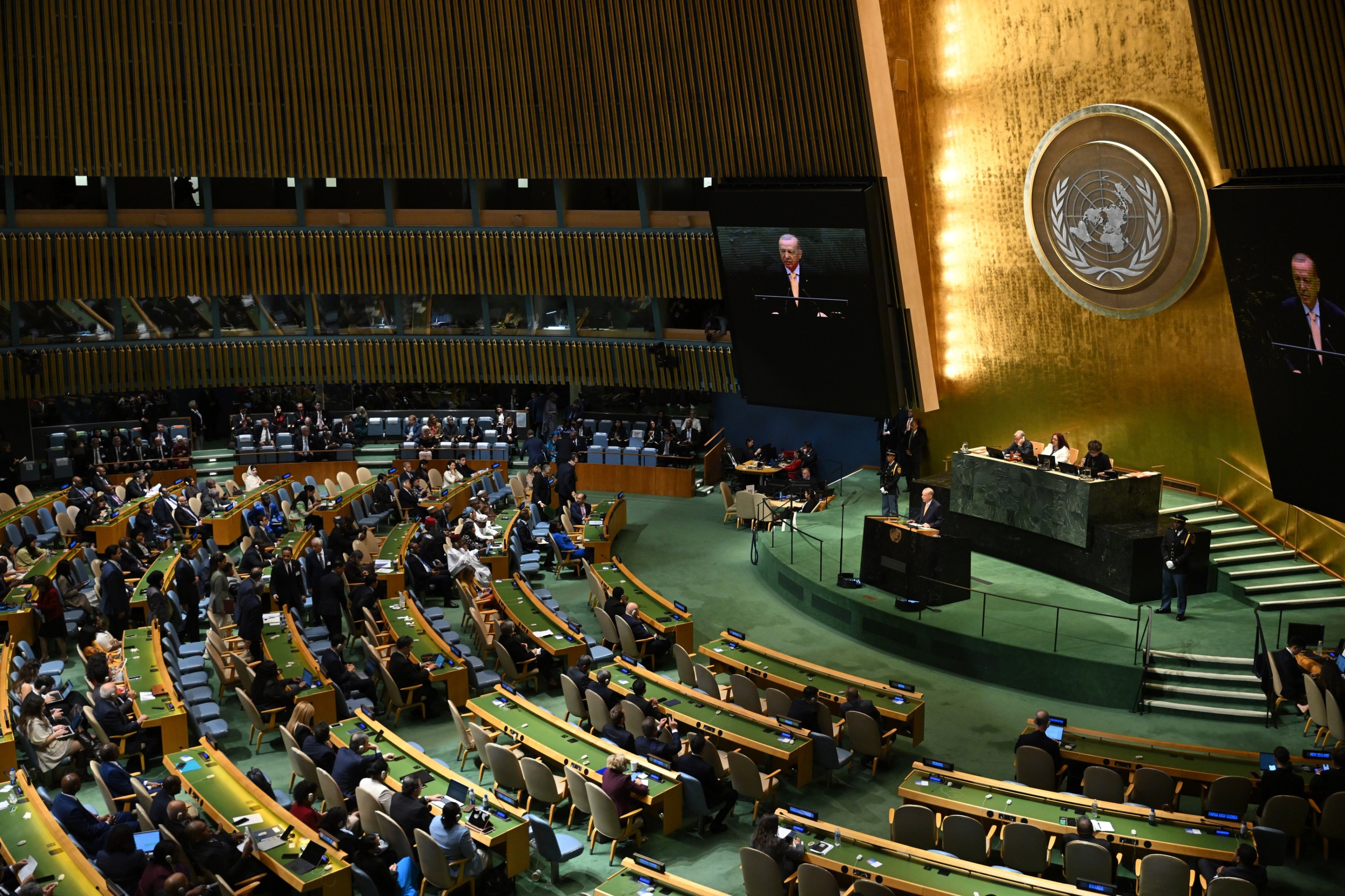
President Recep Tayyip Erdoğan addressed the 81st UN General Assembly, calling for reforms to the international order and criticizing the concentration of power in global institutions.
Key facts
- •The 81st UNGA theme was “Restoring Trust and Managing Transformation.”
- •President Erdoğan advocated for reforms to address the concentration of power in the U.N. Security Council.
- •The United Kingdom, France, and Canada recognized the State of Palestine in 2025.
- •Palestinian President Mahmoud Abbas did not attend the UNGA due to a visa denial by the United States.
- •Türkiye responded to accusations from Prime Minister Netanyahu via a third secretary to maintain diplomatic protocol.
The 81st session of the United Nations General Assembly convened under the theme “Restoring Trust and Managing Transformation.” During the session, Turkish President Recep Tayyip Erdoğan reiterated his long-standing critique of the U.N. Security Council’s structure, famously summarized by the phrase “The world is bigger than five.” The address focused on the need for institutional reform to ensure international legitimacy and effectiveness in an era of shifting global power.
Critique of Global Institutional Architecture
Erdoğan argued that the current distribution of power within the U.N. Security Council remains tied to the conditions of 1945, granting veto privileges to five permanent members while limiting the influence of other nations. He emphasized that this structure fails to reflect the rising political and economic weight of the Global South. Beyond the Security Council, he warned that the concentration of power in areas like artificial intelligence, data, and technology could establish a new form of global hegemony.
Diplomatic Stance on Regional Crises
The address highlighted the Palestinian issue, noting that Palestinian President Mahmoud Abbas was unable to attend the assembly due to a U.S. visa denial. Erdoğan urged countries that have not yet recognized the State of Palestine to do so. During the session, dozens of delegations walked out as Israeli Prime Minister Benjamin Netanyahu began his speech. When Netanyahu later targeted Türkiye and Erdoğan in his remarks, Ankara responded through a third secretary, a move described as a calibrated diplomatic choice to avoid direct high-level confrontation.
Advertisement
This article was independently rewritten by ManyPress editorial AI from reporting originally published by Daily Sabah.