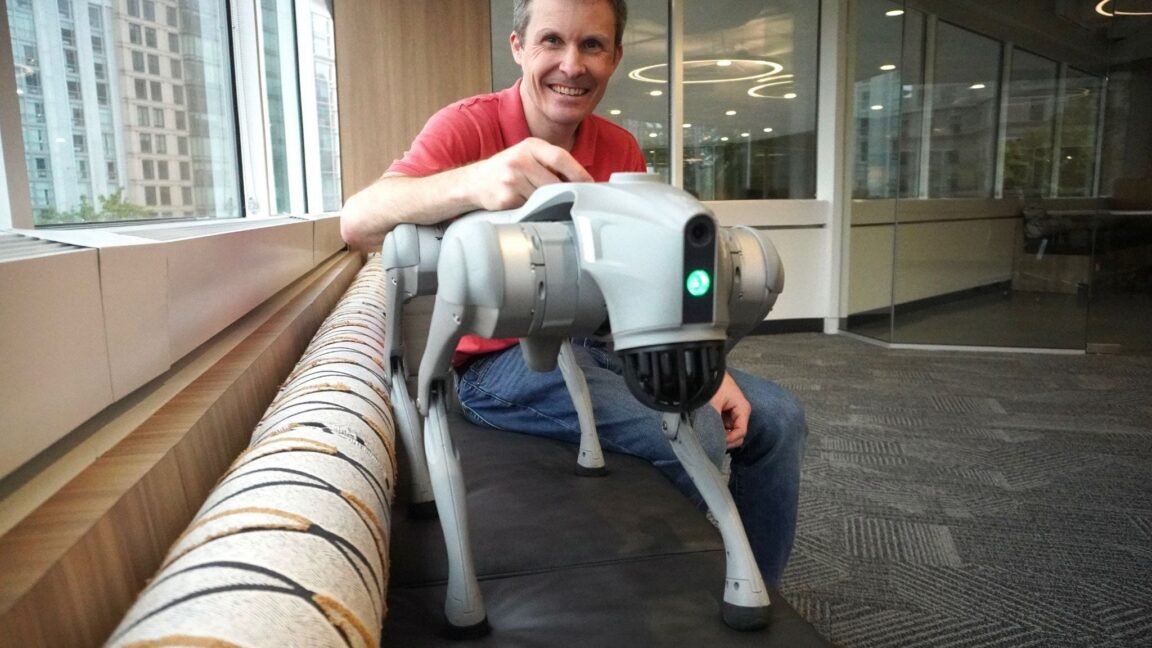
Unitree has become a leader in quadruped robotics by prioritizing affordability and simplified design, making robots accessible to researchers and consumers.
Key facts
- •Unitree quadrupeds use a 6.33-to-1 gear ratio, which is significantly lower than the 51-to-1 ratio used in Boston Dynamics' Spot.
- •The company debuted on the Shanghai stock market on August 19, reaching a valuation of $34 billion by the following Monday.
- •Unitree's humanoid robots, first launched in 2023, are available for as little as $13,500.
- •The Go2 Pro model purchased for this review cost $4,017 after accounting for shipping and tariffs.
- •Unitree was founded in May 2016 by Wang Xingxing, who developed the XDog prototype for his master's thesis.
Unitree, a Chinese robotics company, has gained prominence by producing quadruped robots at a fraction of the cost of industry competitors. By utilizing simplified gear systems and standardized components, the company has democratized access to legged robotics for academic researchers and hobbyists. While these robots are increasingly popular for entertainment and research, they currently face legal restrictions in the United States.
By the numbers
Design Strategy and Cost Reduction
Unitree achieves lower price points by using large motors paired with simple 6.33-to-1 gearboxes, a departure from the high-ratio, high-precision reducers used in industrial robots like Boston Dynamics' Spot. This design choice reduces manufacturing costs and improves backdriveability, allowing the robots to be more nimble and easier to simulate. Additionally, the company uses identical motors across all four legs to reduce part counts and simplify field repairs. Experts note that while these design choices make the robots affordable, they may also rely on lower-quality components that wear out faster than those in more expensive models. The company also benefits from a supportive policy environment in China, including tax credits and public institution purchases, which has helped it scale manufacturing operations.
Market Impact and Financial Growth
Unitree debuted on the Shanghai stock market on August 19. Following its IPO, the company's valuation reached $34 billion by the following Monday, more than triple its pre-IPO valuation. The company has also expanded into the humanoid robot market, launching its first model in 2023 with prices starting at $13,500. For many, Unitree’s quadrupeds represent a shift toward mass-market robotics. While practical applications remain limited compared to wheeled robots or drones, the accessibility of these machines has allowed hobbyists and academic labs to conduct research that was previously prohibitively expensive.
Advertisement
This article was independently rewritten by ManyPress editorial AI from reporting originally published by Ars Technica.