While Roman aqueducts primarily relied on gravity, engineers used siphons and mechanical devices to move water across valleys and up inclines.
Key facts
- •Inverted siphons used pressure generated by descending water to push the flow up and across valley towers.
- •Large header and receiving tanks were essential for allowing air bubbles to escape and preventing air pockets in the siphon system.
- •The Archimedes screw was typically placed at a 30-degree angle to lift water from lower river heights to higher land areas.
- •Ctesibius' pump utilized a hand-operated lever and a piston system to move water through a central chamber.
- •Roman engineers preferred constructing bridges with top channels over building siphons when crossing valleys.
Ancient Roman aqueducts were primarily designed to transport water to cities using gravity. However, when faced with challenging terrain such as valleys, Roman engineers employed specialized techniques like inverted siphons and mechanical lifting devices to ensure water continued to flow, even when it needed to travel uphill.
The Inverted Siphon Method
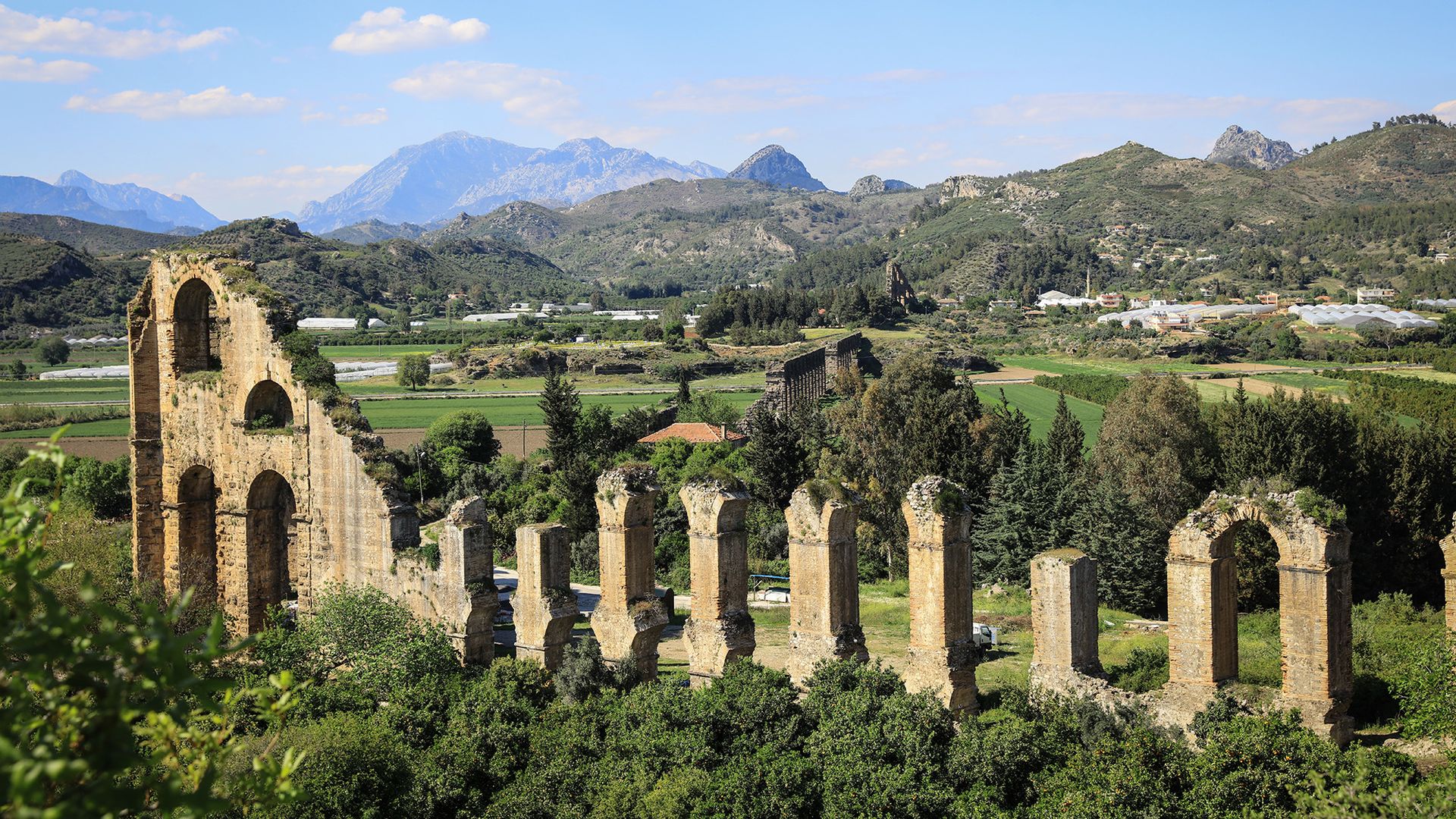
To move water across valleys, Roman engineers utilized inverted siphons. At the second-century A.D. aqueduct in Aspendos, Turkey, this system involved a header tank on one side of a valley and a lower receiving tank on the other. Water dropped down a steep hill, creating pressure that forced the flow up through towers before descending again. To prevent air pockets that could disrupt this process, the tanks were designed to be large enough to slow the water's velocity, allowing air bubbles to escape through the open tops of the structures.
Mechanical Water-Lifting Devices
When gravity and siphons were insufficient, the Romans turned to mechanical tools. The Archimedes screw, a device consisting of a wooden shaft with curved branches inside a pipe, was used to lift water from rivers to higher land when rotated by animal power. Other tools included water wheels, which featured buckets to catch and lift water, and Ctesibius' pump. The latter operated via a hand-moved wooden lever connected to pistons and cylinders, forcing water through a central chamber and out of a nozzle.
Engineering Preferences
Despite their ability to construct siphons, Roman engineers generally preferred to avoid them. According to Charles Ortloff, a research associate at the University of Chicago, engineers favored building bridges with top channels to cross valleys whenever possible. A prominent example of this preference is the Segovia aqueduct in Spain, which features a bridge that remains standing.
Advertisement
This article was independently rewritten by ManyPress editorial AI from reporting originally published by Live Science.